“We have come to this world, to accept it and not merely to know it. We may become powerful by knowledge, but we attain fullness by sympathy. The highest education is that which does not merely give us information but makes our life in harmony with all existence.” –Rabindranath Tagore, 1926
Several years ago I had the privilege of traveling to Honduras a couple of times to work in a children’s village called Nuevo Paraiso. It was, like this trip to India, a transformative experience—but in a very different way. The countryside in Honduras, outside of Tegucigalpa, is remote, underdeveloped, and very poor. It felt to me like going back in time—way back. Life was very basic there. Both times, after about a week, I had to find a private space in the evening to be alone and cry for the desperate poverty in which the residents lived. It put me into emotional overload. It was my first time experiencing that sort of thing—perhaps I would process it very differently now–but I cried for the pain and deprivation of their lives.
In India, in spite of some evident poverty—slums, the red light district, beggars on the streets, huts and shacks adjacent to mainstream shops—I cried for our deprivation, not theirs.
This past weekend we traveled to Santiniketan. I’m not sure what to call it other than an environment, a place (it means “sacred abode”), perhaps a way of life. There we visited institutions started by Rabindranath Tagore—poet, writer, musician, painter, educator, and visionary, oft referred to as the Shakespeare of India—that included a pre-k-12 school and Visva-Bharati University. I’m not sure I would call Tagore the Shakespeare of India. I’d say he’s the John Dewey and the Walt Whitman combined. Like Dewey, his vision was considered progressive in his day (1861-1941) and is still considered progressive today (Sad, isn’t it? We obviously never make “progress.”) I found it deeply moving, not only that he started a school that followed his vision, but that it is still in operation today. And the university, at which he was loathe to grant diplomas or certificates—because learning was to be a natural act that you engaged in for its own sake—was to be an international center, non-denominational, where thinkers and learners from all over the world would be welcome.
We visited the school Sunday morning (their day off is Wednesday). Convocation began in the center courtyard. The entire school assembled:


…as two young boys rang the bell to call them together:


Once the entire school was assembled, the students bowed their heads in prayer:


Then the choir sang:


There were latecomers, just like we have each morning:

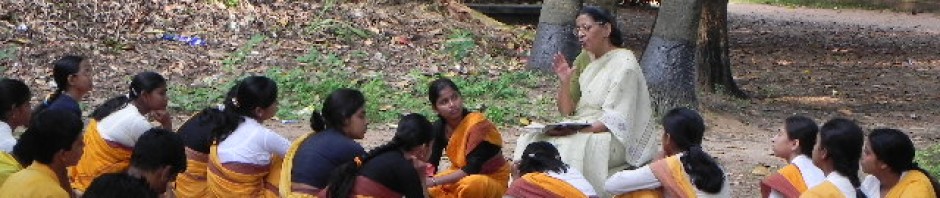
Then they were off!To school–under the trees!


The principal, Bodhirupa Sinha, took us on a tour of the school.


The school’s philosophy, Mrs. Sinah told us, is simplicity and joy. When they graduate, outside, under the trees, of course, they receive a leaf—from the tree under which Tagore’s father used to meditate, on the land where he founded his ashram. The same land that Tagore later transformed into a school, university, and family compound.

I cried for the value system we had lost. I guess it was my emotional watershed moment, but I have been consistently delighted by the students and teachers here. The kids are eager, bright, engaged, and seem to genuinely want to learn. The teachers work harder than anyone should be allowed to work, under dreadful conditions (I wrote earlier about ½ hour classes of 60-90 students in dreadful heat and humidity.) And yet these kids are on top of things.

We in the U.S. like to think that we have a lock on giving kids the freedom to think deeply. We aren’t about rote memorization (we are about NO memorization, and I wonder what part of brain development we are hindering by ignoring the development of that ability). We like to think that we are about critical thinking, inquiry, independent thought and engagement. We like to think that in other countries, the students are forced to sit in rows and regurgitate information. Well, it is certainly not the case in the classrooms I’ve seen here. These students are good at applying knowledge, good at extending their knowledge. They pick up on things very quickly—things our American students would resist. So when I learned of Tagore’s’ vision, and watched the school he envisioned assemble under the early morning sun in August 2011, and watched the students and teachers move to their classrooms under the trees, I cried for the values we had lost.
This school is John Dewey (“Education is not preparation for life; education is life itself.”), it is Walt Whitman (“I loafe and invite my soul, I lean and loafe at my ease observing a spear of summer grass.”), it is Henry David Thoreau (“Simplify, simplify”). It is Emerson and Rachel Carson, it is democratic (the kids were eating a breakfast they had voted on) and idealistic. It is Alfie Kohn and Gerald Graff, it is Deborah Meier and John Taylor Gatto and Lisa Delpit and Ted Sizer and Howard Gardner and it is many of us who believe in education that empowers and liberates, that nurtures the mind and the soul. And it is here, in the heart of India. As we dumb down the national curriculum with high-stakes tests, here children are learning according to a vision that is truly, deeply India, but is also truly, deeply American.
I am struck again and again by how much we have in common ideologically, but keep feeling over and over that on the whole, we have become narrow and cynical, while India is optimistic. She is in growth mode; we are in desperate straits.
It is for these things that I cried as I watched children gather in their yellow uniforms under green trees on a sunny Sunday morning in Santiniketan, here in what looked a bit like the Garden of Eden to me.


At times, it reminded me of Kenyon College. Olivia–they have a “Middle Path:”


and banyan trees:

cows:

and breakfast (they voted for this!):


Don’t you want to go to school here? Under the banyan tree:


Where the school’s philosophy is joy and simplicity?


 There and Back Again: A Teachers Tale
We may have to let Kenyon know about the Indian Middle Path. And I do want to go to school under the trees! I wish Kenyon had class outside that much.
Sorry, dear! Tagore is neither Shakespeare nor Dewey! Rabindranath cannot be compared with anybody. Rabindranath is in it itself! To know him the whole life is extremely tiny! His thinking were way beyond his time and still contemporary today. We cannot catch him with our narrow materialistic mind. Like his idea of not alienating education from nature, his philosophy of love and life is also way to far of realization! If you read him, you will understand love, life, nature and the universe all mingle in a single point transcending any barrier. His universal love and spirituality is worth understanding with our life.
P.S: I am one of the ex-students of Bodhirupa Sinha. Thanks for those pictures. Nice to see her after ages.
A correspondence with Shevanti Narayan led me to this blog post. I am an ex-student of Santiniketan, passed out Patha Bhavana long back in 1975. We run a web-site by ex-students of Santiniketan http://www.muktodhara.org, where regular articles are posted about Rabindranath Tagore & Santiniketan; along with other topics poetry, personal reminiscences etc. We would like to get this post in our site, and in fact any other about Santiniketan that you would like to share with us. For your convenience I am forwarding to you some pages posted in our site which may interest you
1. tapovana School-Genesis of the Idea: http://muktodhara.org/?p=1489
2. Tagorean space: Locating Santiniketan-http://muktodhara.org/?p=1155
3. basanta Utsava: http://muktodhara.org/?p=1352
We would really love to share your ideas with us. I would be very pleased if you can contact me at my email address.
With regards,
Shubhashis Mitra
Santiniketan