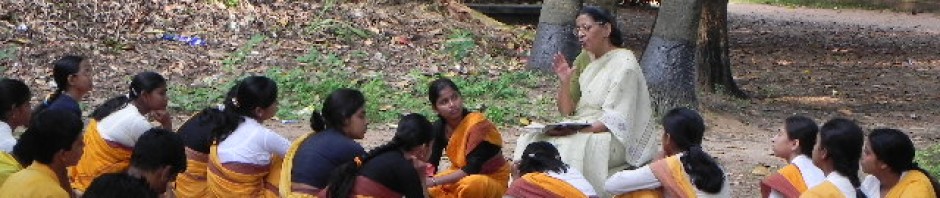
Flights of compassion and imagination: Half the Sky; compulsory curriculum of compassion; Naba Disha

Meeting Urmi Basu and visiting New Light, her shelter for trafficked women and their children:

friday July 22, 2011 new light 110

friday July 22, 2011 new light 128

friday July 22, 2011 new light 131

friday July 22, 2011 new light 105

…Visiting Loreto Sealdah and meeting Sister Cyril, traveling by bus with her students to watch them tutor in the Village Program:

village program 057

village program 199

village program 174

…Meeting the men and women from the villages training to be teachers, and proudly displaying the curriculum materials they have diligently (and meticulously, and expertly) prepared:

village program 042

village program 034

Sister says they are better prepared than the teachers coming out of the universities. I do not know the university programs there, but I do know Sister. I’d lay odds that she knows of what she speaks.

…these are experiences I will never forget.

Here is where I encountered the poor and needy—and witnessed the large hearts of the Indian people. There was no condescension toward the poor. (I have no doubt that they would assure me that it is there, but it still strikes me as significant that it was not visible to me.) Sr. Cyril, as I said earlier in the blog, is the most radical educator I have ever met.

One of the girls who live at the school preparing for class:

st johns & loreto sealdah 132

And another. Notice the bedding rolled up and shelved in the back:

st johns & loreto sealdah 131

Sister sends a trunk, a “school in a box” out to remote areas where there are no schools–the villages, the brickyards, the fisheries:

st johns & loreto sealdah 148

Fifty percent of the population of Loreto Sealdah is poor.

Several years ago, I was a member of the curriculum committee for a school opening in Cleveland to serve the poor. To qualify for the school a family had to be at or below the poverty line. Once that pool of possible students was identified, they were tested, and those who scored highest were admitted. The goal was to choose, from among the poor, those with the greatest chance of succeeding in the school. Sr. Cyril did not test the poor–she chose the poorest of the poor to bring into the school.

Her domestic servant program, in which she asks her students to approach families who keep child domestic servants and manipulate to get them outside (“we’re starting a club for children in the neighborhood…can ___ come for an hour?”). Once they have her (usually a girl) in tow, they ask if she has enough to eat, clothes to wear, if she’s treated well, etc.… What amazes me about this program is the flight of imagination it took to empower and entrust the children with so much responsibility. We would never do that. It would never occur to us to trust our children that deeply, to depend on their ingenuity so fully. Few things help a youngster feel competent and confident more than being given real responsibility—and we are particularly bad at doing that. Sr. Cyril gets it. We need to get it. We need to raise entrusted, empowered children. We have so much to learn.

Finally, I was fortunate enough to be invited to present at the “Indo-US Conference for School Education,” at the American Center in Kolkata. There, I met I KanuPriya Jhunjhunwala, an educational consultant and Shubhra Chatterji the Director of Vikramshila, a non-profit NGO “working in the area of education with the mission of ‘making quality education a reality for all children.’” (http://www.vikramshila.org/)

KanyPriya and I struck up a conversation during the break and we knew right away that we would have to exchange contact information before we left. The program started up before we did so, we agreed to meet up at the end to trade info, and then Shubhra presented. I could hardly stay in my seat until the end of the session, I was so eager to meet this like-minded eductor.

Shubhra and KanuPriya introduced me to the Vikramshila and Naba Disha (New Directions) programs. and the extraordinary work they do with these two exceptional programs. Shubhra is the Director of Vikramshila, a multi-faceted educational support program.

Naba Disha is another social program resulting from a courageous flight of imagination that I think, at this point, is beyond our capability. Started as a supplemental education program for children in the most violent neighborhoods in the inner cities, they asked police stations to host the tutoring sessions—initially because they needed safe places for them to meet. The miraculous, unintended consequence of the program is that the police began taking a paternal interest in the program and started to bond with the children. The result—they no longer see the kids as street urchins or thugs—they know them, they have a relationship with them. The Naba Disha center I visited was housed in a building put up by the police specifically to house them. It looked like a retreat center:

DSCN5328

DSCN5406

The day I visited, there were children from preschool through grade 12 working with tutors (several of them visiting from Ireland). The material and the curriculum were creative and beautiful,

DSCN5399

the room was filled with joy and energy,

DSCN5349

and I was more in love with India than ever:

DSCN5390

DSCN5342

DSCN5338

The result of the conference and the visit to Vikramshila and Naba Dishu is that KanuPriya and I are co-hosting an Indo-US online consortium to continue these conversations regarding the rich similarities and differences between the two countries. I will post here as soon as we are up and running.

Subha far left; KanuPriya on the right:

DSCN5398

Subha and I will continue to be friends. I’m hoping she gets skype soon. We plan to write for funding to continue our work with Urmi and the issues raised in Half the Sky—getting students in the US and India to put their heads together to make both our countries and the world a better place.

I’m not happy that with each passing week all of this is further and further behind me:

indelible images like this one:

santiniketan 196

warm, engaged students:

first day of school!! 011

dear friends and colleagues:

first day of school!! 010

Posted in Uncategorized | 1 Comment

Dear St. John’s Dio….

September 27, 2011

Dear Mrs. Chrestian, Mrs. Lionel, Mrs. Nandi, my friends in the staff room, faculty, and especially students,

It has been nearly six weeks since my stay with you, and I think of you and St. John’s Diocesan every day. Being in your company and a part of such a warm community has been one of the most gratifying and rewarding experiences of my life.

The warmth, joy, and hospitality exhibited by everyone in the Dio community will forever stand as a model to me. Every day, after Mr. Saxena and I negotiated a different taxi fare and navigated a different route to Sarat Bose Road, I stepped foot onto your lovely campus, the rightful winner of the “best maintained school award” for three years in a row. Your beautiful aqua-washed buildings and the lush greenery were paradise to me, a refuge from the delightfully cacophonous but overwhelming streets of Kolkata.

first day of school!! 073

I was greeted each day by warm, genuine smiles from everyone—the men at the gates, the support staff, the teachers, and every girl I passed. I heard “good morning, ma’am,” over and over as I made my way to the staff room each morning. Within the first week I was getting to know some of the older students, but even the middle school girls would sprint across campus to exchange “good morning…how are you?…fine, thank you…how are you?” with me. Always, always with the most lovely of smiles. My keenest and dearest memory of India is of being surrounded by open, smiling faces.

first day of school!! 011

I have taken away critical life lessons. I was eager to see what classrooms of 60 girls would feel like, and quickly discovered how effective a teacher can be even in a large class with engaged and engaging learners. The students at Dio clearly value education, a lesson I want to impart to my own students in the United Sates, and an attitude that is the key to learning.

The girls at Dio are proficient in several languages, most in at least three—Bengali, Hindi, and English. As an educator, it was very exciting to see first-hand the intellectual advantage multi-lingualism provides. Whether I was teaching grammar, poetry, or a literary concept, you girls soaked it all up like sponges. It is clear that you are attuned to language and to linguistic concepts. Of course, your engagement and dedication was not only evident in language classes. Mr. Saxena and I had many, many conversations about the quality and depth of the learning we witnessed at Dio. He was mightily impressed by your skills in mathematics—and by your dedication and obvious engagement in the subject matter. You are living proof to us that understanding the value of education is one of the keys to education itself.

first day of school!! 080

I will always recall fondly attending your quiz tournament and the impassioned preparation for the competition. The energy and excitement that I witnessed on the day of the tournament rivals any celebration or competition we have here in the USA. You know how to make learning not just fun, but a joyous community event.

231

123

104

I loved watching you practice native dances for your Independence Day celebration on August 15. Your marked improvement over the course of the month before my departure and your celebration (very poor timing, indeed) was a revelation.

tuesday july 19, 2011 254

tuesday july 19, 2011 195

tuesday july 19, 2011 148

I heard from several of the teachers that the weather was fine and the performances strong. I was thinking of you all that day, as I do every day now.

I recall how quickly Mr. Saxena and I were made to feel comfortable in the staff room at Dio. It was not long before we were having spirited discussions of cultural mores and differences, of the importance and challenges of building a curriculum that is both accessible and rigorous. I still e-mail some of my new, dear friends, and we hope to continue our dialogue, our friendship, and our professional relationships.

I was privileged to visit your second schools and meet the students there who, like you, value education.

second school 208

second school 072

I witnessed your “1 onion and 1 potato” program. Many girls at the school expressed a concern for the environment, others a keen sense of political awareness. Many, many girls were very interested to learn what I thought of your country. You are good citizens of India and of the world. One after another of you indicated to me that you have a social conscience, a political awareness, and a cultural sensitivity.

I think that if the students of Dio are indicative of the future of India, the country has reason indeed to be optimistic. I would wish the teachers and staff congratulations on such a fine institution and such wonderful students. It is my fondest wish to return one day. Until then, it is a “flat world,” and there is little holding us back from continuing to communicate and collaborate. This is, I hope, not an end but a beginning.

Fondly,
Cindy Sabik
USA

wednesday august 3 075

Posted in Uncategorized | Leave a comment

Reflections, part two… Systems of culture and education:

The congruencies and disparities between India and the U.S. are absolutely fascinating. When I applied for this fellowship, I said that I believe learning happens in a comparative context, but in the aftermath, I’d add that some comparative contexts are richer and yield more than others. The India/U.S. connection is proving to be a rich partnership.

India and the USA are both huge countries with large, diverse populations; both have emerged from under British colonialism, the USA in 1776; India in 1947. Both have chosen to be democracies, value freedom, and seek to design a system of free, public education for all. As a democracy, the USA is 235 years old; India 64. India is an older nation, but a younger democracy. Perhaps this is why so much of Indian culture felt to me like 1950s America: a time of hope, optimism and joy. When I went to see a Bollywood movie, expecting it to be the Indian “Hangover,” it was more like a Bob Hope-Bing Crosby road movie. The actors sang, they danced (with unabashed glee that would be sneered at in the USA); it was didactic (the title, Zindagi Na Milegi Dobara, translates to “Won’t Get Life Back Again” or “Seize the Day”) and filled with hope and joy.

ZINDAGI

I was regularly reminded of Post WWII rhetoric. In India, one of the few growing economies in the world right now, home ownership is becoming a reality for many in the rising middle class. Sound familiar? Here, in the 1950s, as unemployment and inflation remained low, home ownership became a reality for many middle-class Americans. Even a very modest home was a point of pride for many whose grandchildren would lust after “McMansions” only several decades later. A chicken in every pot and a car in every garage became dinner at a restaurant or take-out every night and a car for everyone in the family old enough to drive.

It is not just rampant materialism that has made us into the cynical bunch we are. While I do think that capitalism has trumped democracy, our can-do attitudes were also short-circuited by a series of events, namely the assassinations of JFK, MLK, and Bobby Kennedy, the Watergate scandal, and the prolonged conflict in Vietnam. But India, too, has had to deal with the assassination of the beloved and respected Mahatma Gandhi in 1948, India Gandhi in 1984, and Rajiv Gandhi in 1991. They have lived through years of tension with Pakistan, always under the threat of nuclear war, and like the U.S. struggles with issues of race and class, and separatist movements among its many and diverse religious and ethnic groups. In the U.S., the increasingly polemical evolution of our two-party system has led to a closed narrowness that adds exponentially to current levels of frustration and cynicism. India, on the other hand, has a multi-party system with a variety of small regional parties.

And there are some fundamental differences in our histories and mythologies that I think will cause the Indian post-colonial trajectory to play out differently than ours has. As a country, we are simply young—Native American culture, to the extent we even acknowledged it, was either exterminated (I know, I know—smallpox was inadvertent) or shunted off to reservations. U.S. history more or less begins with the broad markers of Columbus, the landing of the Mayflower, the Revolutionary War, and the founding fathers signing the Constitution. So we are a very young nation—and we often behave like an ill-bred, overgrown adolescent—big, full of ourselves, arrogant, sure of our own immortality, and toying with that very mortality.

But as to the series of internal events that apparently led to our cultural disillusionment, how is it that we emerged from WWII as optimists? I still use that harrowing time as a standard to pull me up when things get dark, as in “if they could pull through that, surely we can survive this.…” But WWII events helped forge our national optimism—it was then (“No ordinary time,” according to Eleanor Roosevelt) that we bonded and faced the challenge of wars on the Atlantic and the Pacific fronts simultaneously (beginning with an already-depleted military). Perhaps it was our adolescent brashness that gave us the “gumption” (to use a 50’s word) to even take on such a herculean task. But we emerged as a super- and nuclear-power—adding initially to our optimism, and eventually to our arrogance. We’re not exactly a pampered adolescent (our history is short, but fraught; our successes are hard-earned). Perhaps what we have is the cockiness of a particularly successful high school quarterback—a youngster who feels that the effort he has exerted—which feels enormous relative to his short life– has taken him to some sort of pinnacle.

India, on the other hand, has certainly come through, and continues to struggle with some pretty cynical-making events of her own. And while her struggle to come out from under British rule, led by Mohandas Gandhi with his doctrine of non-violence, and brought to fruition by his political heir, Jawaharlal Nehru, is rightfully a source of national pride, they too, have dealt with assassinations, terrorism, and government corruption. Even the high school students I taught, when I remarked on the noticeable national pride and optimism, and the growing economy, mentioned significant government corruption as an enormously mitigating factor.

We Americans still tend to think that history is linear—and that the simple line into the future always moves along a positive trajectory. It’s the inheritance of yet another root myth of our own culture, that of manifest destiny—that 19th-century notion that the United States had the right and the duty to settle in and expand through the continent—that it was ‘God’s will.” We were not just God’s chosen people in a religious sense. We were God’s chosen people–politically. That notion fed into a sense of complacency when, as presidential scholar (and Gilmour speaker last Tuesday) Doug Brattebo pointed out,

“In the 1990s, after the Cold War had wound down, [as] the Western democracies enjoyed record economic growth, low unemployment, and a rising stock market for a period of quite some years, there developed on the part of young and middle-aged Americans, I think, a sense that this kind of dependable progress, this kind of upward spiral of reinforcing positive developments, would go on and on and on. It was as if, more than one observer has said, history went on holiday.”

So the arrogance that is the legacy of our myth of manifest destiny was overlaid with a sheen of complacency as “history took a holiday” for the nation with a storied but relatively short history. Like that high school quarterback, we had reached our goal—we thought this was the apex, our laurels were hard-earned but well deserved, and we were done.

India, on the other hand, has a long, rich history, and the wisdom that comes with that experience. Loung Ung, the author of First They Killed My Father, the story of her parents’ murder and her survival of the Cambodian genocide, says that one generation of her family was royalty, the next paupers. She knows that fortunes are transitory; that life is capricious. Loung has inherited a cultural understanding–the result of a long history and a long view of history–of the reflexive nature of human experience. The tide ebbs and flows; it does not move in one direction.

In both cultures, U.S. and India, there is a growing secularism. Their Durga Puja, the big holiday celebration in October that they have compared to our Christmas or Mardi Gras, has become secularized—widely celebrated by members of many and varied religions—it is a 6-day street festival, more a cultural event than a religious one.

The Puritanical religion of our forefathers translated into an uptight attitude and back-breaking work ethic. Their religious history is one of spirituality, even mysticism. Our fundamental myths of bootstraps and self-made men has a heavy emphasis on individualism, and is what we invoke when we sneer at the poor–—they could climb out of poverty if they only worked harder—after all schools are free…. The ethos in India is much more a communal one, and I never once felt the antagonism toward the poor that I hear articulated by the affluent in the USA ever more frequently.

So the questions I’m taking away are related to but different than those I arrived with. Is India on a trajectory toward democracy that will mirror our own? Can they learn from our mistakes? Can we borrow back some of their hope and optimism?

When I discussed this in the staff room, ABan and Sampita assured me that their students, too, are jaded and becoming cynical—but would we not have said the same thing in the 50’s or 60’s? (Oh, we did not know what cynical meant back then. Our much-more-cynical selves could teach our 1950’s selves a thing or two…naïve fools that we were.) When I expressed relief that I saw no sagging pants in India—that ubiquitous (and surprisingly long-lived) American symbol of hip-hop culture and youthful brashness–they assured me that trend had arrived from the west—I simply had not been privy to it yet. To my outside perspective, though, the cynical tone seemed mild if it was visible at all.

So I wonder which elements of our trajectory will play out in similar fashion in India. The growth of materialism is one I suspect will be hard to avoid, but I think their more communal nature and easier acceptance of the spiritual might soften their journey—maybe they will avert some of the hardness and cynicism that has crept into our culture. And maybe, through collaboration with India, we can rediscover and recapture some of the wide-eyed optimism that is a necessary component when you are eager to take on daunting tasks. A sort of deliberate naiveté is, I think, increasingly necessary for educators. No matter how dysfunctional the system, so matter how damaged the community, we must keep on—and with a seriousness of purpose and a smile. There are living, breathing children sitting in those desks right here, right now, depending on us for their future. (See—corny & naïve, but true and necessary!)

Posted in Uncategorized | Leave a comment

Reflections on my journey: Or, an American’s encounter with our better selves [in process]

It’s Saturday morning—I arrived home last Sunday, late afternoon, after 44 hours of travel. (Thirteen hours in Dubai (see Flickr account for pix of Dubai–Disneyland on steriods or for Battlestar Galactica fans–Caprica. No kidding)

dubai 267

dubai 235

and nine of them waiting through delay after delay in Washington DC, for my last, 1-hour flight. (I wanted to get out and walk, I felt so close. Relatively speaking, I was.) The jet lag on this end has been mild—manifested mostly as an inability to stay awake past 9 p.m. Hardly the force that got me up for the day at midnight in Kolkata.

My immediate reaction to the trip, unfolded for every poor soul who asks how it was, has been unflaggingly and overwhelmingly positive. And as I find myself attempting to convey the heart of the experience to my family, friends and colleagues, it is clearly being distilled. Here, improperly edited and manipulated to my specific purpose, is the Wikipedia definition of distillation:

Distillation is a…physical separation process…[with] a number of applications. Water is distilled to remove impurities… Air is distilled to separate its components—for industrial use. Distillation of fermented solutions has been used since ancient times to produce distilled beverages with a higher alcohol content.

We process everything. For the writer/student of the humanities, this process is usually (always?) a process of storytelling (the prison-house of language, Niladri!). What to include, what to omit, what to boil down, what to heighten, what is essential, what lies at the core. To distill, to clarify, to remove impurities, to create essential oils, pure solutions, concentrated mixtures. We call it distillate, essence, concentrate; essential oils.

So I separate components—my friendship with Subha & Niladri; the school, including my relationship with the teachers at my table in the staff room at St. John’s & the students & the experience of teaching them and of just being present at the school; my experience of the city itself, it’s culture, history, landmarks, its sheer “overwhelming-ness”; and perhaps most striking, apart from the depth of connection with Subha, are the social service/educational programs, the move toward educating everyone, the exploration of what education is and means in an unfolding democracy.

And I boil the trip down to essential elements—in order that both personally and professionally I might excise and retain the core ideas, ideals and experiences—so they might inspire me now and, I hope, in days to come.

My trip may have started with a stomach-ache (no one escaped the dreaded Delhi-belly), sleeplessness (midnight—really?), homesickness (exacerbated by the long nights), culture shock (heat, crowds, pollution, horns, smells—Kolkata is NOT a Walden experience!) but in the telling and retelling of my story, it glows. Much of what I am distilling, you may have read in its initial form if you followed the blog. This is the story of what is staying with me and why. Here is my distillate:

1. My oxymoronic statements to Mark: I kept telling him he would hate it in Kolkata. After all, he hates the locker room at Lifetime Fitness because it’s crowded. He gets frustrated when there isn’t a bench available for him to sit his gym bag on as he gets ready for spinning class. AND he hates heat. Can you imagine him walking out of the Grand Hotel into the heat and smells and crowds, with beggars tugging on his elbow and vendors imploring him to “just look… my shop is right over here”…and the odors and the constant cacophony of the car horns…?

on the street outside our hotel

Yet, I keep telling him that he MUST go back with me. I love the culture and the people, and I need to go back and I want him to experience what I experienced. The kindness, the genuine smiles, the compassion toward the poor. One of the things both Mark and I find most tiresome and disturbing here is the palpable animosity toward the poor*. I never–never once–encountered that in India—and believe me, the poor are there—far more visible than they are here. (And I want him to meet Subha. I want the two of us to hang out with Subha and Dhruba and talk culture and politics and life….)

2. The students: What a pleasure to teach language and literature to kids who are multi-lingual. Most of the girls I taught at St. Johns were at least tri-lingual. The national language is Hindi, their native tongue is Bengali, and the language of the classroom is English. I have always known that multilingualism from an early age enhances brain development, but to see it in action is astonishing. The “prison-house” of language has flexible bars, Niladri, and these kids are facile learners. Here in the USA we tend to be such literalists—we’ve been schooled to be that way. And so we think that a facility with words makes you better only with words, and tend to ignore the greater implication of that—that a facility with words makes you more facile with THOUGHTS. They are better thinkers! Whether I was teaching them vocabulary, grammar, poetry, literature, or just what they call “unseen comprehension”—interpreting an excerpt on the spot—they are much more adept than my American students tend to be. They are more sophisticated thinkers–better at picking up on nuance.

first day of school!! 090

It was delightful to teach in such a classroom, to teach such children, but it saddens me to realize how much we are missing. We still tend to pressure many immigrants to leave their native tongue behind. We fail to support bilingualism in schools, and we reify English as the standard when what we should be reifying is multilingualism, critical perspective and the ability to think and to express what we think clearly and thoughtfully–to use language to discover what we think. We fail to value multi-lingualism and all that it implies. We are missing the boat in a big way. We MUST begin to require a second language—in a deep and significant way—from the earliest grades.

first day of school!! 083

This facility is not limited to the language arts as we like to call them. Our group included two math teachers (one was Ashu, my colleague at St. John’s) and a science teacher and they, too, were impressed by the sophistication of their students. According to Ashu, the 6th graders there were at or ahead of his 10th graders at his private school in North Carolina. Audra, our science teacher, was impressed by the way the different branches of science were threaded throughout the curriculum so that each area (chemistry, physics, biology) was not new when they encountered it in the 9th, or 10th, or 11th grade. It made them more receptive to the material. We were all impressed, regardless of the subject area.

Ashu and I had many long conversations about “rigor,” some between the two of us, some including the teachers at our table in the staff room. He and I intend to pursue the topic and present on it (NAIS, AERA?) and we plan to continue the conversation with Subha, ABan and Sampita from the staff room. (Thank you, digital age).

We also had to call into question some of the broad generalizations leveled at the Indian and American systems of schools. Speaking in the very broadest of terms, the preconception I took with me to India was that in the Indian system teachers teach to high-stakes tests (they do), that learning is largely under pressure (it is) and by rote, and that, such a high-pressure system yields automatons who know the content but don’t really go deep with it (very wrong on that one). Our consolation in the US is our notion that we are educating a large, heterogeneous population (which will limit performance–we are; but so are they) and that we are better at the constructivist approach—that we take the time for a lesson to unfold, that we allow our students a role in that unfolding, and that by definition, means our students are going more deeply into the material. While the early TIMMS studies challenged that notion (here we discovered that we are very worksheet-dependent, and do not go as deep as either Germany or Japan—at least in the classrooms studied), and while there is probably some truth to the notion (we do take more time to allow a lesson to unfold over days and the students are more active participants in that unfolding than in the several classrooms we witnessed—but it is pretty hard to form and follow-up on collaborative groups in a classroom with 60 students in a 40-minute lesson) the Indian students were engaged and engaging, asking and answering provocative questions. They were rigorous in BOTH ways—covering content AND going deep. When they had opportunities to display the application of content material, they rose to the challenge with eagerness and skill.

At any rate, my ultimate point is that while they are preoccupied with coverage, they still ask excellent questions; while they do move at a faster pace than we do, the students, generally speaking, are keeping up with the pace, and they are asking excellent questions. When asked about the material, they are grasping it at a deeper level, and when asked about application, they were capable of applying the knowledge in various contexts.

It’s hardly a scientific study, but it is what we saw in our brief time there. And we reluctantly acknowledged that some of our pacing is not so much because we are allowing the lesson to unfold and the students to drive it, as much as we are giving in to the protests that the material is too challenging and in response we are “dumbing it down,” often for the slower students in the classroom. When we explained this to Mr. Francis, he replied that their students would (“of course”) do the same thing—but they refuse to give into that pressure.

So of course, this goes back to one of our earliest impressions—that of courtesy and a cultural valuing of education. When you walk into a classroom in India, every child stands to greet you, waits to be given permission to sit. Some American teachers were put off by what they perceived as a forced subservience. But it didn’t feel that way to me. (Again—a drive-by observation, but for now it’s all I have.) There is a culture-wide valuing of education that we do not have in the US. It might be a mile wide and an inch deep as we like to say about content coverage, but it is still in place, it is the door through which they enter, and it means they start in different space than we do here. And this leads to one of my other distillates….

[coming next: Systems of culture and education; Flights of compassion and imagination: Half the Sky; compulsory curriculum of compassion; Naba Disha; and Continuing; extending. Connections, collaborations]

*(see today’s New York Times editorial: http://www.nytimes.com/2011/08/31/opinion/the-new-resentment-of-the-poor.html?_r=1)

Posted in Uncategorized | Leave a comment

Niladri Makes Me Look Up

Also known as: Niladri’s Sunday Morning/Monsoon Walking Tour

Also known as “Art, Culture & Niladri”

Kolkatamorous: (adjective) the state of being in love with Kolkata. In French, Kolkatamoureux. This word can be traced back to Monday, 8th August 2011, when a certain Niladri R….*

Okay, I’m a fan. I knew I loved him our first full day here when he presented to us and pointed out that one of the gods was clearly gay. I’ll have to go back and review the evidence with him, (and even get reminded as to who the fortunate young god is!) but I loved it. I was laughing through my jet-lagged eyelids as I learned about the history & culture of Niladri Chatterji’s beloved Kolkata. He gave us a chronology of the city, an obsessive work of love (did we have the latest version? And when we took the walking tour, did we have the newest latest version?) which ranged from “the Portuguese traders come to Bengal from Goa” in 1535, to May 13, 2011: “Trinamul-Congress alliance comes to power, ending 33-year Left Front rule. New Govt. sworn in on 20 May.”

He was putting together a walking tour, trying it out on another group, but would not have time to take us on the tour. Those of us who were developing an intellectual crush on him were very disappointed. So when he presented himself at a dinner with the other group of teachers with whom he had clearly bonded, we jealously pounced. Where was our tour? And the endlessly generous-hearted Niladri agreed to take us on the tour on Sunday morning. The streets of Kolkata are at their quietest (a relative term in this city) on Sunday mornings.

We would leave at 6. Moans and groans. 7. Complaints. 8? Okay, we would leave at 8. Our troops were being depleted—the dreaded “Delhi belly” had hit us—hard. To the point where the doctor made house calls (hotel calls?) for three of us. So we were fading fast. Several decided that sleeping in outweighed either cultural excursion or bonding with Niladri, and a drizzle-cum-monsoon (although we knew it only as a steady drizzle as we left the hotel that morning) brought us down to four. So the hard-core among us (Keturah, Audra, Lena and me) went forth and lifted our eyes.

niladri's walking tour 025

This, mind you, is no small feat. The streets here are teeming. From the knees down, there are dogs, goats, the occasional rodent, uneven sidewalks, bricks everywhere—some from new construction, some crumbling and uneven…there are the innumerable feet of others. A pedestrian must be ever-attentive to the below-the-knee fracas, as well as to all the activity from eye-level down. Vendors, beggars, people, people, people… when crossing the street, do not forget the cars that KEEP MOVING as they approach you in an intersection… colors, sounds, smells…. Developing the skill set necessary to negotiate the streets of Kolkata had been a new learning curve for many of us, and it kept our five senses firmly locked into a claustrophobic gaze tilted downward. Niladri raised our gazes skyward.

On that rainy Sunday, protecting our cameras from the drizzle while trying to shoot some of the first non-overexposed film of the trip, we looked at the buildings as we walked down the street beginning at Shyambazar 5-point crossing, down Bidhan Sarani to the ancestral home of Swami Vivekananda. We looked up—at art, architecture and history. We saw, in Kolkata, the Raj era, Kolkata’s original “Miracle Mile” ala Chicago, New Orleans-style balconies and ironwork, Art Deco…under the grime and soot of an over-populated and polluted city that also suffers from the mold and dampness of monsoon season. On top of all that—is a gorgeous panoply of culture, history and design. Niladri lifted our eyes and, through the raindrops (which you will note on the photos) we were delighted.

niladri's walking tour 047

niladri's walking tour 070

niladri's walking tour 051

niladri's walking tour 026

niladri's walking tour 062

niladri's walking tour 037

niladri's walking tour 039

Freedom fighter’s snack shop (freedom fighteres have to eat too!):

niladri's walking tour 061

niladri's walking tour 058

After shooting what FELT like a ton of shots, I don’t seem to have one of all of the art deco touches. Shoot. More details to follow, but on my last morning in Kolkata, this is all I have time for. A few pix from the walking tour that ended on a tram as the monsoon gained force. We were going to have breakfast with Niladri and his delightful friends who share our enthusiasm for both the city and the guide, a group of intellectuals who also lifted their eyes skyward with Niladri and asked and answered thoughtful questions. Unfortunately, survival meant leaving them early, trudging through 6-inches of rain in a gulley-washer that made it a challenge to keep the camera dry and juggle the umbrella, and not slip!

Nomoshkar, Kolkata. Final blog entries will be constructed in Cleveland, Ohio–beautiful, aging, Midwest, rust-belt city.

niladri's walking tour 083

niladri's walking tour 082

*Full definition:
This word can be traced back to Monday, 8th August 2011, when a certain Niladri R. Chatterjee coined it in the course of a chat he was conducting on facebook, a social networking site, with a certain Cindy Sabik. They had been on a short, but very wet, walk of a street in north Kolkata the day before and were musing about how one tries to use words to impose order on this formless thing called life. At first Chatterjee called himself a Kolkatactivist, but soon realized that that would not be entirely accurate. Yet. So, he came up with a word that would better suit what had been slowly taking shape in his heart for a year or so, but had now appeared to him fully-grown, powerful and compelling – his love for the city he was born and raised in. Yes, he realized, he had fallen in love with a city that he had always lived in but had never paid any attention to. He had moaned about its chaotic roads, its water-logged monsoons, its punishing heat, its casual approach to filth, its lack of public transport after 10 pm, but had never stopped to look at the buildings. He had never considered looking at buildings and streets as silent story-tellers. He had never considered that a street can be synecdochic of a city, a crystallization of its history and character.
And then, something happened on 23 July 2010. He found himself introducing a delegation of American academics to Kolkata. As he talked the visitors through an abbreviated history of the city, he thought, “This is odd! My city is actually interesting!! It has a fascinating bunch of stories to tell!!!” And thus began his exploration of the known (as phrased by his friend Zaid Al Baset). Only Chatterjee would put the known within inverted commas, because he hardly knew Kolkata. Not that he knows the city much now. But at least now he knows that he does not know. He wants to. He is a man in love. In love with Kolkata. He is Kolkatamorous.

Citation: Niladri’s facebook page. See—don’t you have an intellectual crush on him now, too?

niladri's walking tour 024

Posted in Uncategorized | 1 Comment

Second Schools, Mother Teresa, Loreto Sealdah and the Village Program

If I needed proof of the truth of Martin Luther King’s statement that “the arc of the moral universe is long but it bends toward justice,” I needed only to come to Kolkata (only!?) where the response to great need, in so many cases, in so many ways, has been great goodness. Mother Teresa was not the first, is not the last, is only the most renowned.

wednesday august 3 130

We have been to New Light (http://www.newlightindia.org), Urmi Basu’s shelter (featured in Half the Sky )for trafficked women and their children.

This past week, Subha took us to visit St. John’s Second Schools (small schools set up in slum areas where for part of the day very poor children can attend school in their neighborhood, typically after work); and Mother Teresa’s Motherhouse and Children’s Home. Friday we went to Loreto Sealdah (http://www.loretosealdah.com) to witness Sr. Cyril’s vast conglomerate of social service programs centered around the school. And Saturday we traveled with her students to observe them tutoring children in the villages.

So last Tuesday, Subha took Ashu and me to visit St. John’s Diocesan’s “second schools.” Many area schools have small second schools set up in the slums and poorer areas where children can go to school near their homes. A branch of Diocesan was set up in 2004 in the Bamunbagan slum area, where 26 children are come for two hours in the afternoon. They typically work in the morning—at their family vegetable cart, or at a chai stand or the like. A second school was opened at Bedford Lane, off Ripon Street on Children’s Day in 2005. The school started with 52 children, who are regularly provided with nutritious mid-day meals, uniforms, bags, and books. Here you find the little ones–the school has classes from nursery to standard II. Several of these students go on to Diocesan each year on full scholarship.

The way there:

second school 087

second school 088

second school 086

second school 090

second school 091

When we arrived, they had gifts and garlands for us, just as they had at the main school. The children recited poems, sang songs, and three of the older children performed an engagement dance—they were absolutely gorgeous. Beautiful, beautifully dressed in traditional clothing, well-rehearsed in this elaborate dance. It was tremendous. (Ashu was talked into trying the dance. His soccer skills came in handy.) We talked and shared, and promised we’d come back to teach a lesson. I doubt we’ll have time, much to our dismay.

second school 071

second school 061

second school 066

second school 062

second school 059

second school 058

second school 046

Then we went to the other second school, the one for the little kids:

second school 199

second school 212

second school 208

second school 193

The kids playing outside:

second school 219

second school 215

I had promised my Dad I’d try to get to Mother Teresa’s. I was hoping I could bring him a rosary for his collection. (Can you believe, while in the states, I was imagining a gift shop there? Still think it’s a good idea….) The Motherhouse was, for the most part a shrine—at least the parts we were permitted to see. We could only take photos of the statue/entryway, and the tomb. (Okay—I didn’t know she was literally still there!) Shrines don’t always move me the way programs and people do, but this one was tasteful. Her small, austere room was preserved; there was a mini-museum with a pictorial overview of her life, the tomb…

wednesday august 3 135

And the chapel, with the Eucharist displayed on an altar and a small statue of Mother Teresa crouched in the corner in the back of the room in the spot where she would pray.

I wondered if the museum/shrine would mention Sister’s “dark night of the soul,” revealed in letters to a German monk that were made public a year or so ago. They did—it was acknowledged I one of the later panels. She struggled with what she felt was desertion by God, what I would have called depression. It makes me wish so very deeply that we weren’t such literal, fragmented souls (on top of being such fragile souls). If she, or those around her, had the capacity to understand that a spiritual crisis is, if only framed slightly differently, a psychological crisis, perhaps she could have received counseling. Of course, it was an earlier time, and a different era. Psychology was not as developed, nor as accepted as it is now. However, when Time magazine did a feature story on Mother’s spiritual crisis, they too, (even that secular “news” magazine) called it a spiritual crisis, a “desertion” by God, and nothing more. We are so peculiar when it comes to matters of faith. At any rate, it is precisely this untreated or uninterrupted crisis of the soul that makes Mother Teresa so very compelling for me—or rather, makes her sacrifice so great—super-human, in fact. This is how my (small) reasoning goes: Of course she would suffer from depression. How could you live among the poorest of the poor, the sick, the elderly, the dying, in the slums of Calcutta, and not get depressed? For all we know, she may have been suffering from a form of post-traumatic stress disorder. After all, she was working on the front lines of the real “war on poverty.” Now, my reasoning goes, I can see someone choosing to dedicate his or her life to living simply and serving the needy and getting a deep sense of joy and satisfaction from that. As difficult as it may be, if it is your calling, there are benefits to be reaped. I, however, live in fear of depression—I think it can be very difficult to move past, and I find it, even in small doses, debilitating. So here is where –at least for me—Mother Teresa’s sacrifice goes beyond anything I could ever be capable of. This crisis of the soul went on for years. And she stayed. She continued to put the needs of the poor before her own needs. She did not leave for a little r & r. She did not retreat to heal herself in order to return when she was able. She plowed through that darkness—even when she thought God himself had deserted her. Spiderman, Batman, Hercules…something super-human or mythological was at work in her. She had, if not powers, at least capabilities that transcend the mere mortal. She rose above her fragility in ways I cannot fathom.

Friday we went to Loreto Sealdah, Sr. Cyril’s school. Another super-human entity, whose down-to-earth demeanor and direct, honest manner belie the steely CEO who obviously directs this social transformation conglomerate. The school is the center–the heart—of her programs. The student body makeup is 50% the poorest of the poor, and which includes programs too numerous for me to remember. They include the 247 street children who live in the school (“We realized the school building stood empty every day from 3 p.m. until 8 a.m. the next morning and there were children living on the street outside,” said Sister), and the Domestic Child Labor Program in which students are to keep their eye out for children kept as domestic labor (i.e., de facto slaves) in their neighborhoods. They knock on the family’s door and do what they can to get the child (typically a girl) out of there (i.e., “we’re starting a neighborhood club for children…”) then ask about their life (are you fed? clothed?, treated well?), then get them out on a regular basis to play, learn, talk…. (Can you even imagine charging an American child with such an important and nuanced task? Not that they wouldn’t be willing or able—it’s just that I cannot imagine such a task presenting itself, nor can I picture us having the imagination to present the task to children.) In the Village Program, Loreto Sealdah students travel an hour by bus to go into the Villages every Saturday (each girl goes once per month) to tutor the children in grades 1-4. They have a “mandatory curriculum of compassion.” Sr. Cyril is one of, if not the most, radical educators—social activist, really–that I have ever met. She says this “is not social work—it’s education for social transformation.”

st johns & loreto sealdah 140

st johns & loreto sealdah 132

st johns & loreto sealdah 167

Sr. Cyril at work:

village program 023

Saturday, we boarded the bus with her students and headed out into the Village to observe them in their roles as tutors:

Boarding the bus:

village program 068

village program 051

Walking to the village:

village program 165

village program 144

village program 143

village program 163

village program 142

village program 157

village program 161

village program 150

village program 133

village program 135

village program 155

village program 154

village program 132

The local dump?:

village program 147

At the school:

village program 172

village program 174

village program 171

village program 170

The 6th graders I observed. They tutored a group of a dozen first graders for 2 hours:

village program 199

At another Village school:

village program 205

Village teachers at Loreto Sealdah, engaging in professional development:

village program 044

“School-in-a-box,” ready to be sent out into the villages & brick factories:

st johns & loreto sealdah 148

Posted in Uncategorized | Leave a comment

The hotel

My next post will be about Loreto Sealdah, the Village Program, and St. John’s second schools—all amazing programs to help the very poor. It has been a real privilege to see these places, and the people who have created them, run them, and work in them. More about that later. Today: the hotel.

Each day, we walk away from this juxtaposition of selflessness and poverty and return to The Grand Hotel. The Oberoi Grand, a relic of the Raj era, of British grandeur and colonialism, is mentioned in Jeffrey Eugenides’ short story in the summer fiction issue of the New Yorker: “A few blocks away, up Jawaharlal Nehru Road, was the Oberoi Grand, with its turbaned doormen.” The story is set in 1983; the turbaned doormen are still here.

saturday, july 16 042

The opulence is still here. It is one of a chain of luxury resort/spa/hotels. (Check out the one in the Himalayas: http://www.oberoihotels.com/oberoi_wildflowerhall/index.asp.)

In the lobby (notice the HUGE flower arrangement behind us. It gets changed every couple of days. different each time):

030

hallway at the oberoi

sleeping headquarters

021

We come home to classical music, flowers, service unlike anything we have ever experienced (every employee smiles and greets you every time they cross paths with you! Imagine their in-service training.) There is a complimentary cappuccino delivered to my room each morning shortly after my wake-up call. The young man brings the paper in with it (saving me the trouble of opening the door and removing it from the door handle myself.) My room is cleaned every day; usually by Gourav whose parents are teachers, but he studied hospitality. He carefully arranges every single toiletry item I own every morning. I found myself complaining to Bree that I was aggravated that they keep setting everything up to the left of the sink, so that every morning I have to move everything back to the right, where I like it. (In my defense, I am right-handed.) Today I wondered why there was not the usual flower blossom floating in the finger bowl that comes with the two fresh mangoes. (Just sayin’!)

016

Every day we have two large bottles of bottled water delivered to the room, along with two fresh mangoes. A turn-down service every night straightens the bed, (brings two more mangoes if you’ve finished yours) closes the curtains, and places the room service breakfast menu and the next day’s weather predictions on your pillow. I have a fuzzy white bathrobe and slippers every day (I was horrified when they forgot my bathrobe several times. Gourav was very apologetic.)

I’ve been reminded on more than one occasion of David Foster Wallace’s essay, “A Supposedly Fun Thing I’ll Never Do Again” (thank you Jon Wanders!) in which DFW documents a cruise he took because “a certain swanky East-Coast magazine [Harper’s] approved of the results of sending me to a plain old simple State Fair last year to do a directionless essayish thing. So now I get offered this tropical plum assignment w/ the exact same paucity of instruction or angle” (256). They send him on a Caribbean luxury cruise on Celebrity Cruise Lines. They want, he says, “a sort of really big, experiential postcard.”

His experience came to mind for me while I packed. When he was preparing to leave for his cruise, he did not follow their suggestion to pack formal wear, including a tuxedo. He regretted his decision when every man on the cruise showed up for an event in a tuxedo and he showed up in a T-shirt with a tuxedo design on the front (I remember those!). Just because you really don’t care doesn’t mean you won’t feel awkward. I packed a dress and shoes for the more formal dinners they said we’d be invited to. I didn’t need them (everyone tends to wear the lovely, all-purpose Indian salwars), but I have found myself in situations too many times in which I wished I’d followed advice (as in, I don’t think we’ll really need an umbrella…) At any rate, because of DFW, I did pack dressy clothes.

And my fussiness about my toiletries, and notice of the missing blossom, is cannily realized when he says:

The Infantile part of me is insatiable—in fact its whole essence or dasein or whatever lies in its a priori insatiability. In response to any environment of extraordinary gratification and pampering, the Insatiable Infant part of me will simply adjust its desires upward until it once again levels out at its homoeostasis of terrible dissatisfaction. And sure enough, on the Nadir itself, after a few days of delight and then adjustment, the Pamper-swaddled part of me that WANTS is now back, and with a vengeance. By Ides Wednesday, I’m acutely conscious of the fact that the AC vent in my cabin hisses (loudly) …By now I notice that when Table 64’s towering busboy uses his crumb-scoop to clear crumbs off the tablecloth between courses, he never seems to get quite all the crumbs. (317)

The afternoon that I took a nap, then went to a short program meeting and returned to find my bed made, this passage came to mind:

After a couple of days of this fabulous, invisible room-cleaning, I started to wonder exactly how Petra [Gourav!] knows when I’m in 1009 and when I’m not. …For a while I try experiments like all of a sudden darting out into the 10-Port hallway to see if I can see Petra hunched somewhere keeping track of who is decabining, and I scour the whole hallway and ceiling area for evidence of some kind of camera or monitor tracking movements outside the cabin doors—zilch on both fronts. But then I realize that the mystery’s even more complex and unsettling than I’d first thought, because my cabin gets cleaned always and only during intervals where I’m gone more than half an hour. [Here, too! I have never walked in on Gourav or anyone else cleaning my room.] When I go out, how can Petra or her supervisors know exactly how long I’m going to be gone? I try leaving 1009 a couple times then dashing back after 10 or 15 minutes to see whether I can catch Petra in delicto, but she’s never there. I try making a truly unholy mess in 1009 and then leaving and hiding somewhere on a lower deck then dashing back after exactly 29 minutes—and again when I come bursting through the door there’s no Petra and no cleaning. Then I leave the cabin with exactly the same expression and appurtenances as before and this time stay hidden for 31 minutes and then haul ass back—and this time again no sighting of Petra, but now 1009 is sterilized and gleaming and there’s a mint on the pillow’s fresh new case. (297-298)

I haven’t reached DFW’s level of paranoia, probably because I’m out most of the day, and because it’s not as much of a mystery here. If you walk down the hallway, you will see a staff member, or 6. This place is an anthill of activity. And they communicate! If they are cleaning the room and something is missing or awry, they quietly get on their cell and get someone up here. And they come—immediately.

Apparently the staff likes us—we are nice and friendly. Much of that is probably due to the fact that we are not the uber-wealthy they are likely accustomed to. We are, as anyone knows (and if you didn’t, the message has certainly been driven home recently, especially in Ohio and Wisconsin) solidly working class. So when the hotel invited us to a cocktail party with hotel personnel, we thought they were giving us the opportunity to socialize with the service staff. Oh silly Americans. It was a monthly event with gorgeous women and handsome men from their corporate offices. They mingle with the guests among drinks and hors d’oeuvres and hand out business cards and ask how their stay is. The service staff here, on the other hand, will not get on the elevator with you—even if you are the only one on the elevator. Even if you hold the door and invite them in. They wait for the next one. I imagine that sometimes that is a long wait. Like I said, can you even imagine the in-service training?

Posted in Uncategorized | 1 Comment

Teachers

When I began teaching high school, one of my most delightful discoveries was the sense of community among the staff. I’d been teaching on the university level for 7 years, and I had made some wonderful friends there–and we certainly shared professional interests, but it was actually a bit counter-cultural within the university system where professors are independent operators, each with a research area in which they invest their time. And while I believe this has changed a bit at at some colleges, I do think it is still the standard to worry more about your discipline, your content and your research & writing than about pedagogy. After all, the general model is that college students are adults, and as such are responsible for paying attention and mastering the material. High school students are still considered children and thus there is an implied obligation, I guess, to demonstrate to them how compelling the work can be (I’m SO tempted to insert a smiley-face here. Niladri, look what you started!) At any rate, among the high school staff I discovered a group of people who did several things I was not accustomed to. They were present in the institution all day (college profs teach their classes, hold office hours, then disappear–researching , writing, sailing… JUST KIDDING all you hard working profs. The rest of you–admit it.) The teachers on the high school level shared a vested interest in pedagogy. We spent a great deal of time together worrying about how young people learn and about how young people learn best. I found a community like that here, too.

The teachers at St. John’s are terrific. I feel like I belong there. At my table in the staff room are Anuradha Banerjee, a lovely, gracious and intelligent woman and gifted teacher who goes by the nickname, A-Ban. It cracks me up. It sounds like she should be partners with Mr. T! Helen Sarkar (I’m her only friend because everyone else pesters her about her diet, while I share fried mo-mo’s with her) who obviously commands both the love and the respect of the students, Angela Naik who shares her food and her wisdom with me on a daily basis, my friend and mentor, Subha, quiet, smiling Sunit, the who teaches computer & Hindi, and I’m not sure how to spell her name, but the new psychology teacher, Schompita who wonders at Americans who go home from work to more work. She can’t imagine it as she has a cook and a maid and a driver and someone to do her laundry, as many middle class people do in India.

I love these women. They share home and school stories, food, and advice. We have had conversations about education, politics, child-rearing, and cultural similarities and differences. I absolutely love the students at St. John’s, but I’m pretty sure it is the staff I will miss the most. A-Ban, Schompita, Ashu and I were deeply in the middle of a discussion of discipline in education (meaning rigor, not behavior) when we decided to carry the discussion on and develop it online—perhaps producing a cross-cultural paper on the topic.

A-Ban and Angela grading:

A-Ban & Angela in the staff room

Teachers on the other side of the staff room:

teachers on the other side of the staff room

There are four tables, each with eight seats, so the upstairs staff room accomodates 32 teachers, each with an assigned seat. I believe I displaced a poor teacher who has been relegated to the downstairs staff room until I leave. She gets her seat back in 5 days!

staff room

They have been my rescuers during the daily tiffin break. Tiffin (http://en.wikipedia.org/wiki/Tiffin) is a light meal—we’d probably call it a substantial snack or a light lunch. Teachers bring theirs in from home (except Helen who often buys fried mo-mos or other yummy, unhealthy items from the commissary!) A-Ban usually brings in sliced cucumber and almonds (which she soaks in water overnight, making them plump and fresh-tasting. At first I thought they just had way-better almonds in India.) Angela brings in pomegranate seeds, sliced fruit, something different nearly every day. Sunit often has delectable food in his tiffin box that his wife has prepared.

Sunit hard at work correcting papers:

first day of school!! 065

Mrs. Chrestien very kindly made arrangements for something from the commissary to be sent up to me and Ashu each day during our tenure here. I had my first tiffin break in her office the first day of our arrival, and I was jet-lagged and starving, and the small sandwich tasted okay to me. In subsequent days, I discovered that it was dark chicken meat and butter—I don’t eat dark meat, and I cannot (as in, I’m not able to) eat cold butter. It gags me. (Mark can testify—if there is even a dot of unmelted butter on my toast, I cannot eat it. I know it makes me sound like a petulant six-year-old, but what can you do?) I also don’t generally eat white bread. (I think this is the point where I lose the right to say I’m not a picky eater. I’m really not…. I just have a few issues.) I managed to choke the sandwich down one or two more days, but then I simply couldn’t. Of course the teachers noticed and word was sent to please send me something different, so they sent me cucumbers and tomatoes on white bread—with butter. I really couldn’t handle it. Angela called down for them to send me some bread without butter and helped me wipe the butter off the vegetables (it doesn’t all come off!) and they sent up four more pieces of white bread. In Kolkata, where you walk past the poor and homeless every day, I felt like an ungrateful, petty, spoiled prima donna. (I also shouldn’t eat the tomatoes—we only eat peeled fruit. Vegetables that are washed in unfiltered water, even when they are dry, may be carrying the bacterium that makes so many foreigners ill.) I was at a loss. And it kept coming. The teachers kept sending messages. The next day it was just a pile of sliced white bread! I could not stop laughing.

As this went on day after day, and I watched my friends bringing in their tiffin boxes filled with delicious Indian delicacies, or buying samosas or fried mo-mo’s from the commissary, I confided to them that I had loved everything I’d eaten in India so far except for these darn white-bread-with-butter sandwiches. They confided that they would not eat them either. The next day Helen bought me a mo-mo, and I asked why I keep getting these sandwiches when there is such delicious food available. Because, they replied, that’s what they think you want. Aaargh.

Tuesday and Wednesday I got mo-mos. Happy day.

Posted in Uncategorized | Leave a comment

Taxis and the middle ground

It occurred me today that a couple of the things that confound Americans, namely what look like amazingly erratic traffic patterns and the infamous Indian head bob, are deeply emblematic of Indian culture, and they highlight a fundamental difference between the Indian mindset and the American mindset.

When I’m in the taxi on the way to school in the morning, the driver invariably drives down the center line—even if there are no other cars around. My American reaction is, of course, “pick a lane!”

And our body language systems are so very different. We nod our heads in a clear pattern for yes and another for no. We have a third gesture—the shrug for “I don’t know.” Our system provides unambiguous and consistent answers. Indian people move their heads from side to side in a manner that confounds Americans. The yes nod is not as firmly affirmative as our clear nod, but a graceful, extended sideways acquiescence. The kids explained the side-to-side motion to me. They hate to say no, they explained.

After I pondered that, it occurred to me that the taxi driver, in a city in which driving is a constant (and I mean constant) negotiation, will choose to occupy the middle ground, even when nothing else encroaches, because it allows him the freedom to go in either direction as the need arises.

In other words, on a day-to-day basis, Indian people are more comfortable occupying ambiguous middle ground than Americans are, and thus more flexible.

What is the result of this? For us, it is a polarized society in which people think they know answers—even when they don’t. A society in which people choose a “side,” even before they’ve considered options, much less nuances. A society in which we must choose between narrowly defined categories—pro-life or pro-choice, democrat or republican, right or wrong. (And we are coming dangerously close to sending the world into a financial crisis because of our rigidity.) We are not good at subtlety or nuance—those staples of thoughtful argument and considerate living.

The Indian ability to occupy the middle ground results in minor miracles that occur multiple times for each taxi ride I take. Narrowly averted collisions are the standard. Pedestrians do not even flinch as the huge yellow taxi barrels toward them; rickshaws dive right into the narrow space between a bus and a truck; bicyclists merge into congested, turning, horn-blowing traffic, just like any other moving vehicle. If you want to cross the street, you have to dive in–you must take a step into moving traffic—otherwise they keep moving, and you never get the opportunity. I am pretty convinced that if I were to attempt to drive here, I’d never move more than a foot or two. I’d be waiting for a safe, assured, clear distance, and traffic signs and lights. I’d be waiting for my turn. In a city of four and one half million people, there are no turns. The system is elaborate, extended, and for the most part, it works. (I guess I should reveal here, even though it weakens in my argument, that there have been two girls who came into school limping this week, one from a bus incident, the other from a taxi incident.) But think about it—the ability to shift from left to right on an as-needed basis? Hello House and Senate. Time for a trip to Kolkata.

second school 135

second school 136

second school 138

second school 130

second school 137

While I’m on the subject of traffic, let me tell you about the taxi drivers. They will try to get away without using the meter. Even when the guard stationed outside of the gate of the Oberoi (yes, yes, I know) tells the driver to use the meter, halfway there we look and the meter is off. Now we have no meter and no negotiated price.

One member of our group rode with a driver who was smoking a joint (yes, while driving!). I think that one wins, but in descending order from there, Bree and I were riding in a taxi that—you guessed it– hit a car. Took his bumper off, then got into a yelling match with him, then drove away. All I could say was, “did we just commit a hit-and-run?” One driver was on his cell phone while weaving in and out of traffic, WHILE going through EVERY red light we came to. (Subha says he was showing off for us.) And the least offensive or dramatic, but still on my list, was the taxi driver who threw litter out the window while ferrying us.

The photos, by the way, do not convey several essential elements of the traffic congestion–the constant movement, the constant negotition, and the noise. It is always, always, an adventure. And never a relaxing one.

Posted in Uncategorized | 1 Comment

Tagore’s houses and Visva-Bharati University (“where the world has a nest”)

Rabindranath Tagore came from a wealthy family (the “Calcutta Medici.” His grandfather, Prince Dwarkanath, was the first independent merchant of British India) and over the course of his lifetime, in spite of dwindling fortunes, he built five different houses near Santiniketan. His son was apparently the architect or designer. The houses struck me as very reminiscent of Frank Lloyd Wright and his prairie style. While Purba Banerjee, a Tagore scholar and translator, and our guide through the newly restored houses, had not heard of a connection or influence there, she did know that Tagore’s son, Rathindranath Tagore, did study in Illinois. Wright, of course is from Chicago and some of his most famous work, including his home, can be found there. Rathindranath Tagore lived from 1888-1961 while Wright lived from 1867-1959. Who knows…? If there’s anything there, it’d be a great dissertation topic for an architectural history student.

Purba:
343

328

292

The grounds are breathtakingly beautiful, and the houses are lovely.

321

285

341

340

336

296

346

344

324

303

Progressively smaller, each has an east-facing room where Tagore slept and worked, so that he could get up each morning before dawn and watch the sun rise from his window.

The view from his window:

286

290

On the wall:

355

345

He was the first Nobel laureate from the East; was well-travelled, and well-connected. (He was friends with Gandhi and Einstein; Yeats edited his work and wrote an introduction to one of his books…. How do these guys manage to find one another?) So many luminaries had passed through his doorways, including, of course, Gandhi, with whom he famously disagreed on some subjects. (What kind of a friendship would it be if you couldn’t disagree on a few things?) At any rate, Gandhi visited him in one of the houses. Shubha has a story about Tagore being very excited at the prospect of Gandhi’s reception of his “mud house.” But Gandhi, according to Subha, was apparently more interested in simplicity than in aesthetics. Tagore was clearly interested in aesthetics, as borne out in the lovely houses and grounds that we toured:

322

301

306

325

300

The university is the most cosmopolitan place I’ve seen in India yet. (Of course, I’ve only been to Kolkata and Santiniketan). The fine arts department, in particular, is bustling with activity and one sees students of all races, creeds and cultures.

238

216

231

209

224

our tour guide, a sculpture student from Delhi:

270

275

273

242

256

There is a lot of traffic on campus; but very little of it comes in the form of an automobile:

260

218

One thing that has surprised me is that Kolkata, while diverse in terms of the many groups that make their homes here, is much less diverse than any city I’ve seen in North America or Europe (because, you know, I’m so widely travelled). There are not very many westerners—or at least fewer than I expected, and our group member from New York City, Keturah, has blogged about how uncomfortable it is to be a black woman in Kolkata, especially one with an afro. We have all witnessed the stares she gets walking down the street. And the kids here are very aware of racial tensions in the U.S. (On my first day here, one of the girls asked me if I liked black people.)

His vision of the university was of a cross-cultural meeting place where East could meet West, to the benefit of both. Still a good project; still incomplete.

From “Tagore’s Vision for the Future,” by Uma Dasgupta:
[Tagore] insisted that the psychology of the world had to change in order to meet the new environment of the new age. Europe was at the time conceiving a League of Nations. Tagore wrote enthusiastically that this was a momentous period for India and Asia to restore their spirit of cooperation in culture and heal the suffering of peoples of the modern age from the divisive politics and materialistic greed which were vitiating even the citadels of education. He called for the study of history and cultures as a rational way of fighting the forces of war and aggression. He spoke out for the need of higher ideas in politics to save humanity. He wrote, ‘even though from my childhood I have been taught that idolatry of the nation is almost better than reverence for God and humanity, I believe I have outgrown that teaching, and it is my conviction that my countrymen will truly gain their India by fighting against the education which teachers them that a country is greater than the ideals of humanity.’”

234

236

229

198

190

157

155

Posted in Uncategorized | 2 Comments