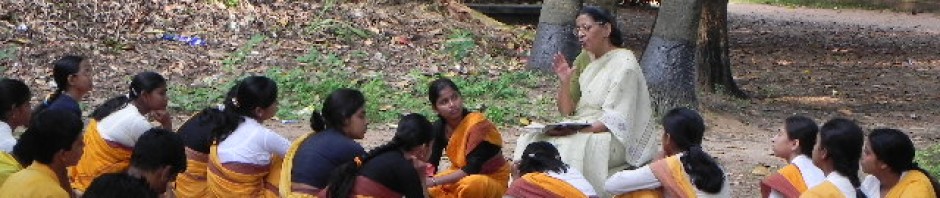
At St. John’s school, some of the girls opt to take English as a first language. It’s NOT their first language; they just choose to approach it as such. It is essentially an advanced class, at about the level of our AP class in the USA. Subha has asked me to teach figurative language to the 10th grade FL (first language English) class. I put together a PowerPoint presentation defining simile, metaphor, and personification, then attempt to come up with examples of each. Similes—okay—stars can twinkle like diamonds in any culture, I think. Personification—okay. When pigs think or talk, it’s personification in any language. My stumbling block came when I tried to come up with metaphors. First there were the names. I don’t really know Indian names, and it would certainly be culturally tacky to have all of my examples start with Johnny, Suzy, etc. But then the real problem. I was pretty certain that they didn’t say “work like a dog,” “strong as an ox,” or stubborn as a mule.” Metaphors—at least every one I could come up with—seemed to be very culturally and contextually specific. I left the PowerPoint page blank. They could give me names, we would discuss metaphors.
It was exactly the right thing to do. They laughed. Would you say “I could eat a cow?” I asked. (Actually, I think we say we could eat a horse. At any rate, they laughed and said they don’t eat cows. Well, we don’t eat horses, either. Maybe that’s what makes the metaphor work—you’re so hungry that you would eat something that is not only huge, but that we normally would not consider eating!) At any rate, we played cultural give-and-take. They gave me (I know, we lapsed back to similes):
…as hungry as a monster
…as strict as Hitler. (okay—we might think he’s a bit more than strict, but we would most definitely get that one.)
…work as hard as a donkey or a buffalo. (I protested that buffalo just stand around like cows. No, no, they said—they plow the fields. Oh. That’ll do it.)
…as foolish as a donkey.
…as sweet as a bird.
…as faithful as a dog. (man’s best friend in any culture. Except for the street dogs, but that can be saved for another post.)
I need to go back to them and have them complete “It’s as hot as…..”
They are something else, though. When they were creating similes, they came up with school as “a second home,” and “a magic world.” English class was “as knowledgeable as an encyclopedia.” Who wouldn’t want to teach here?
An understanding of figurative language established, we moved on to some poetry. And of course, if you know me, you know that I love (not hallmark card love—literary love. This is the real thing) Emily Dickinson. So we practiced spotting figurative language using Emily Dickinson.
Poem one was one of her riddle poems. If you are not familiar with it, read it first, and see if you can guess what it is:
A narrow fellow in the grass
Occasionally rides—
You may have met Him—did you not
His notice sudden is—
The Grass divides as with a Comb–
A spotted shaft is seen—
And then it closes at your feet
And opens further on—
He likes a Boggy Acre
A Floor too cool for Corn—
Yet when a Boy and Barefoot—
I more than once at Noon
Have passed, I thought, a Whip lash
Unbraiding in the Sun
When stooping to secure it
It wrinkled, and was gone–
Several of Nature’s People
I know and they know me—
I feel for them a transport
Of cordiality—
But never met this Fellow
Attended or alone
Without a tighter breathing
And Zero at the Bone–
Did you guess it? It’s a snake, of course. The students here got that without too much trouble—but then, they are pretty familiar with snakes. They also got “zero at the bone” right away. American students sometimes struggle with that metaphor. Right away one of the girls said, it’s when you feel like jelly. Of course!
And we did this one:
A Route of Evanescence
With a revolving Wheel—
A Resonance of Emerald—
A Rush of Cochineal—
And every Blossom on the Bush
Adjusts its tumbled Head—
The mail from Tunis, probably,
An easy Morning’s Ride—
Glossary: Cochineal is red; Tunis is in Africa.
Now, I was worried. According to Wikipedia, there are no hummingbirds in India. They have a bird they claim is close, but I don’t know if its tiny wings whir the way a hummingbird’s do—creating a “route of evanescence.” I don’t think the girls got the answer (it’s a hard one), but they do know what hummingbirds are.
This last one was going to be interesting:
It sifts from leaden sieves,
It powders all the wood.
It fills with alabaster wool
The wrinkles of the road.
It makes an even face
Of mountain and of plain—
Unbroken forehead from the east
Unto the east again.
It reaches to the fence,
It wraps it rail by rail
Till it is lost in fleeces;
It deals celestial veil
To stump and stack and stem—
A summer’s empty room—
Acres of joints where harvests were,
Recordless, but for them.
It ruffles wrists of posts
As ankles of a queen,
Then stills its artisans like ghosts,
Denying they have been.
The answer is snow—and of course, they do not have that here. The kids got it right away, though, and then they really enjoyed the pictures I brought of Cleveland snow. (I got a few gasps!) And, they were terrific at identifying the similes, metaphors and use of personification. It was great fun! And they seemed to appreciate Dickinson’s use of unusual images. They are a very gratifying audience to teach to. They asked if I could bring more next time. Sigh! Can I take them home with me?


 There and Back Again: A Teachers Tale
hey there and thank you for your info – I have definitely picked
up anything new from right here. I did however expertise a few technical points using
this site, as I experienced to reload the website many times
previous to I could get it to load properly. I had been wondering if your web host is OK?
Not that I’m complaining, but sluggish loading instances times will very frequently affect your placement in google and can damage your quality score if ads and marketing with Adwords. Well I am adding this RSS to my e-mail and could look out for much more of your respective intriguing content. Make sure you update this again soon.