Santiniketan

“We have come to this world, to accept it and not merely to know it. We may become powerful by knowledge, but we attain fullness by sympathy. The highest education is that which does not merely give us information but makes our life in harmony with all existence.” –Rabindranath Tagore, 1926
Several years ago I had the privilege of traveling to Honduras a couple of times to work in a children’s village called Nuevo Paraiso. It was, like this trip to India, a transformative experience—but in a very different way. The countryside in Honduras, outside of Tegucigalpa, is remote, underdeveloped, and very poor. It felt to me like going back in time—way back. Life was very basic there. Both times, after about a week, I had to find a private space in the evening to be alone and cry for the desperate poverty in which the residents lived. It put me into emotional overload. It was my first time experiencing that sort of thing—perhaps I would process it very differently now–but I cried for the pain and deprivation of their lives.
In India, in spite of some evident poverty—slums, the red light district, beggars on the streets, huts and shacks adjacent to mainstream shops—I cried for our deprivation, not theirs.
This past weekend we traveled to Santiniketan. I’m not sure what to call it other than an environment, a place (it means “sacred abode”), perhaps a way of life. There we visited institutions started by Rabindranath Tagore—poet, writer, musician, painter, educator, and visionary, oft referred to as the Shakespeare of India—that included a pre-k-12 school and Visva-Bharati University. I’m not sure I would call Tagore the Shakespeare of India. I’d say he’s the John Dewey and the Walt Whitman combined. Like Dewey, his vision was considered progressive in his day (1861-1941) and is still considered progressive today (Sad, isn’t it? We obviously never make “progress.”) I found it deeply moving, not only that he started a school that followed his vision, but that it is still in operation today. And the university, at which he was loathe to grant diplomas or certificates—because learning was to be a natural act that you engaged in for its own sake—was to be an international center, non-denominational, where thinkers and learners from all over the world would be welcome.

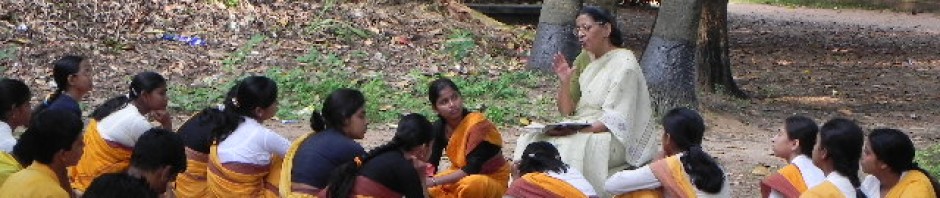
We visited the school Sunday morning (their day off is Wednesday). Convocation began in the center courtyard. The entire school assembled:

santiniketan 104

santiniketan 115

santiniketan 113

santiniketan 118

santiniketan 120

santiniketan 116

santiniketan 192

…as two young boys rang the bell to call them together:

santiniketan 128

santiniketan 108

santiniketan 107

Once the entire school was assembled, the students bowed their heads in prayer:

santiniketan 144

santiniketan 143

santiniketan 145

santiniketan 146

Then the choir sang:

santiniketan 148

santiniketan 147

santiniketan 141

There were latecomers, just like we have each morning:

santiniketan 151

Then they were off!To school–under the trees!

santiniketan 153

santiniketan 217

santiniketan 198

santiniketan 193

santiniketan 200

santiniketan 180

santiniketan 168

santiniketan 171

santiniketan 184

santiniketan 219

The principal, Bodhirupa Sinha, took us on a tour of the school.

santiniketan 223

santiniketan 124

The school’s philosophy, Mrs. Sinah told us, is simplicity and joy. When they graduate, outside, under the trees, of course, they receive a leaf—from the tree under which Tagore’s father used to meditate, on the land where he founded his ashram. The same land that Tagore later transformed into a school, university, and family compound.

santiniketan 158

I cried for the value system we had lost. I guess it was my emotional watershed moment, but I have been consistently delighted by the students and teachers here. The kids are eager, bright, engaged, and seem to genuinely want to learn. The teachers work harder than anyone should be allowed to work, under dreadful conditions (I wrote earlier about ½ hour classes of 60-90 students in dreadful heat and humidity.) And yet these kids are on top of things.

santiniketan 203

We in the U.S. like to think that we have a lock on giving kids the freedom to think deeply. We aren’t about rote memorization (we are about NO memorization, and I wonder what part of brain development we are hindering by ignoring the development of that ability). We like to think that we are about critical thinking, inquiry, independent thought and engagement. We like to think that in other countries, the students are forced to sit in rows and regurgitate information. Well, it is certainly not the case in the classrooms I’ve seen here. These students are good at applying knowledge, good at extending their knowledge. They pick up on things very quickly—things our American students would resist. So when I learned of Tagore’s’ vision, and watched the school he envisioned assemble under the early morning sun in August 2011, and watched the students and teachers move to their classrooms under the trees, I cried for the values we had lost.

This school is John Dewey (“Education is not preparation for life; education is life itself.”), it is Walt Whitman (“I loafe and invite my soul, I lean and loafe at my ease observing a spear of summer grass.”), it is Henry David Thoreau (“Simplify, simplify”). It is Emerson and Rachel Carson, it is democratic (the kids were eating a breakfast they had voted on) and idealistic. It is Alfie Kohn and Gerald Graff, it is Deborah Meier and John Taylor Gatto and Lisa Delpit and Ted Sizer and Howard Gardner and it is many of us who believe in education that empowers and liberates, that nurtures the mind and the soul. And it is here, in the heart of India. As we dumb down the national curriculum with high-stakes tests, here children are learning according to a vision that is truly, deeply India, but is also truly, deeply American.

I am struck again and again by how much we have in common ideologically, but keep feeling over and over that on the whole, we have become narrow and cynical, while India is optimistic. She is in growth mode; we are in desperate straits.

It is for these things that I cried as I watched children gather in their yellow uniforms under green trees on a sunny Sunday morning in Santiniketan, here in what looked a bit like the Garden of Eden to me.

santiniketan 201

santiniketan 206

At times, it reminded me of Kenyon College. Olivia–they have a “Middle Path:”

santiniketan 202

146

160

158

218

and banyan trees:

santiniketan 216

cows:

252

and breakfast (they voted for this!):

110

141

131

116

138

Don’t you want to go to school here? Under the banyan tree:

082

050

Where the school’s philosophy is joy and simplicity?

046

028

025

Posted in Uncategorized | 3 Comments

Kumartuli

In what will certainly be, in the end, one of the highlights of the trip, Subha and Nilayan took us to Kumartuli, a 400-year old artisan village, a pottery center (Natalie heaven!) in northern Kolkata. There, craftsmen spend 2-3 months preparing for the annual 4-day September festival, Durga Puja, honoring the goddess Durga. It is the biggest festival in this festival-happy city. Each village, each community, has their own image of Durga that they shop for here in Kumartuli, then use during the festival. After the festival, they dip her in the sacred river, and the clay (according to my students) can be re-used. The paints and dyes used to be among the pollutants of the river, but there is an effort underway to use organic materials.

Durga, wife of Shiva, is a fearsome goddess—she is invincible, with eight arms, carrying various weapons, and riding a lion or a buffalo. The artisans begin with straw forms, cover them with clay (from the Ganges), and mold them into forms representing Durga, and her children—Ganesh (with the elephant head, the remover of obstacles), Kartikeya, Lakshmi and Saraswati (the goddess of knowledge, music and the arts).

The artisans begin with straw forms, cover them with clay and mold them (the stage they were in when we went through the village), then in later stages plaster, paint and decorate the idols. They get shipped all around the world.

Here’s what we saw:

idols 096

idols 087

idols 121

idols 082

idols 090

idols 120

idols 118

idols 140

idols 135

idols 134

idols 108

idols 111

idols 072

idols 064
It was very difficult to get a shot in which his hands were not a complete blur.

idols 065

idols 053

idols 068
(ta-da!)

And on the way out of town, a stop at a tea stand:
idols 251

idols 250

idols 239

idols 248
Nilayan

idols 207
a beautiful evening!

Posted in Uncategorized | Leave a comment

From The Times of India: Skilled labourers abandon Kumartuli before Puja season

The Times of India seems to be following us around and doing a story on whatever we happen to be doing at the moment:

Skilled+labourers+abandon+Kumartuli+before+Puja+season.

Heads up, Times reporters. We are off to Santiniketan for the weekend. (http://en.wikipedia.org/wiki/Santiniketan)

Posted in Uncategorized | Leave a comment

Teaching Emily Dickinson in India

At St. John’s school, some of the girls opt to take English as a first language. It’s NOT their first language; they just choose to approach it as such. It is essentially an advanced class, at about the level of our AP class in the USA. Subha has asked me to teach figurative language to the 10th grade FL (first language English) class. I put together a PowerPoint presentation defining simile, metaphor, and personification, then attempt to come up with examples of each. Similes—okay—stars can twinkle like diamonds in any culture, I think. Personification—okay. When pigs think or talk, it’s personification in any language. My stumbling block came when I tried to come up with metaphors. First there were the names. I don’t really know Indian names, and it would certainly be culturally tacky to have all of my examples start with Johnny, Suzy, etc. But then the real problem. I was pretty certain that they didn’t say “work like a dog,” “strong as an ox,” or stubborn as a mule.” Metaphors—at least every one I could come up with—seemed to be very culturally and contextually specific. I left the PowerPoint page blank. They could give me names, we would discuss metaphors.

It was exactly the right thing to do. They laughed. Would you say “I could eat a cow?” I asked. (Actually, I think we say we could eat a horse. At any rate, they laughed and said they don’t eat cows. Well, we don’t eat horses, either. Maybe that’s what makes the metaphor work—you’re so hungry that you would eat something that is not only huge, but that we normally would not consider eating!) At any rate, we played cultural give-and-take. They gave me (I know, we lapsed back to similes):

…as hungry as a monster
…as strict as Hitler. (okay—we might think he’s a bit more than strict, but we would most definitely get that one.)
…work as hard as a donkey or a buffalo. (I protested that buffalo just stand around like cows. No, no, they said—they plow the fields. Oh. That’ll do it.)
…as foolish as a donkey.
…as sweet as a bird.
…as faithful as a dog. (man’s best friend in any culture. Except for the street dogs, but that can be saved for another post.)

I need to go back to them and have them complete “It’s as hot as…..”

They are something else, though. When they were creating similes, they came up with school as “a second home,” and “a magic world.” English class was “as knowledgeable as an encyclopedia.” Who wouldn’t want to teach here?

An understanding of figurative language established, we moved on to some poetry. And of course, if you know me, you know that I love (not hallmark card love—literary love. This is the real thing) Emily Dickinson. So we practiced spotting figurative language using Emily Dickinson.

Poem one was one of her riddle poems. If you are not familiar with it, read it first, and see if you can guess what it is:

A narrow fellow in the grass
Occasionally rides—
You may have met Him—did you not
His notice sudden is—
The Grass divides as with a Comb–
A spotted shaft is seen—
And then it closes at your feet
And opens further on—
He likes a Boggy Acre
A Floor too cool for Corn—
Yet when a Boy and Barefoot—
I more than once at Noon
Have passed, I thought, a Whip lash
Unbraiding in the Sun
When stooping to secure it
It wrinkled, and was gone–

Several of Nature’s People
I know and they know me—
I feel for them a transport
Of cordiality—
But never met this Fellow
Attended or alone
Without a tighter breathing
And Zero at the Bone–

Did you guess it? It’s a snake, of course. The students here got that without too much trouble—but then, they are pretty familiar with snakes. They also got “zero at the bone” right away. American students sometimes struggle with that metaphor. Right away one of the girls said, it’s when you feel like jelly. Of course!

And we did this one:
A Route of Evanescence
With a revolving Wheel—
A Resonance of Emerald—
A Rush of Cochineal—
And every Blossom on the Bush
Adjusts its tumbled Head—
The mail from Tunis, probably,
An easy Morning’s Ride—

Glossary: Cochineal is red; Tunis is in Africa.

Now, I was worried. According to Wikipedia, there are no hummingbirds in India. They have a bird they claim is close, but I don’t know if its tiny wings whir the way a hummingbird’s do—creating a “route of evanescence.” I don’t think the girls got the answer (it’s a hard one), but they do know what hummingbirds are.

This last one was going to be interesting:
It sifts from leaden sieves,
It powders all the wood.
It fills with alabaster wool
The wrinkles of the road.
It makes an even face
Of mountain and of plain—
Unbroken forehead from the east
Unto the east again.
It reaches to the fence,
It wraps it rail by rail
Till it is lost in fleeces;
It deals celestial veil

To stump and stack and stem—
A summer’s empty room—
Acres of joints where harvests were,
Recordless, but for them.
It ruffles wrists of posts
As ankles of a queen,
Then stills its artisans like ghosts,
Denying they have been.

The answer is snow—and of course, they do not have that here. The kids got it right away, though, and then they really enjoyed the pictures I brought of Cleveland snow. (I got a few gasps!) And, they were terrific at identifying the similes, metaphors and use of personification. It was great fun! And they seemed to appreciate Dickinson’s use of unusual images. They are a very gratifying audience to teach to. They asked if I could bring more next time. Sigh! Can I take them home with me?

Picture5

Picture4

Picture3

Picture1

Picture2

Posted in Uncategorized | 1 Comment

Doors of Kumartuli

I love pictures of doors–usually I take photos of doors to historic authors’ houses (Emily Dickinson and the like). Yesterday, at Kumartuli, I shot a few doors (and doorways):

idols 194

idols 164

idols 195

idols 196

idols 215

idols 227

idols 198

idols 197

idols 170

idols 169

idols 178

idols 179

Posted in Uncategorized | Leave a comment

Saturday-Monday, July 23-25, 2011

So much to catch up on and to reflect on. For your edification and reading pleasure, I offer up a proposed “table of contents:” visiting with Subha; The Marble Palace; The River Ganges/Hooghly; a Bollywood film; teaching Emily Dickinson in India; AND (if there is any writing energy left) some reflection

Visiting with Subha
Subhalakshmi Nandi and I bonded on e-mail long before I even arrived. We are very close in age, temperament and experience—and share a philosophy that goes beyond pedagogy. In her first e-mail to me she joked that she has “strong ESP” that told her that there would be a close friendship between us. Who could resist such an overture? Subha is a magnetic personality.

She is Fulbright Teacher Exchange alum. She visited Flagstaff, Arizona, fall semester 2005. She lives in a four-story house—she and her charming husband, Dhrubajyoti (Dhruba), live on the ground floor. Upstairs, her various in-laws occupy different floors—Dhruba’s parents on one, her brother and sister-in-law and their adorable 3-year-old another, and another brother and his family have only recently moved. She described all of this to me via e-mail, then wrote “let me know of your matters of the heart and mind.”

New friend. Even before I arrived.

So Saturday night she had me over for dinner. Her driver picked me up at the hotel and took me to her house. We had tea and cookies and talked. In fact, we talked for several hours. Our first online inclinations were correct—we have a great deal in common and chatted like old friends for the entire evening. She gave me a tour of her house, so I met her mother- and father-in-law, her sister-in-law and darling little niece. Her dog wasn’t crazy about me. Her cook prepared dinner for us. I ate; she waited for Dhruba.

Her house is comfortable and charming—with wonderful artwork on the walls, and clever little touches everywhere. There is a little courtyard filled with beautiful plants in the center between her living room and her kitchen—although I liked it less when she told me that a snake had dropped off of the enormous tree, planted by Dhruba as a child, that provides generous shade to all four floors of relatives. It landed in the courtyard. She and her mother-in-law and sister-in-law struggled to get it out. It was narrow and had it gotten into one of the rooms, would have been very difficult to track down. Now anyone who knows me (Barb Elliott?) can tell you that I blanch at the mere mention of a snake. (And I was reminded of my son-in-law, Matt’s, grandmother who recently had her own battle with a snake cornered in her bathroom. I believe it was poisonous, right, Matt?). If I remember correctly, she did it in with a broom and some drain-opening chemicals. India—central Pennsylvania—it’s woman vs. nature wherever you go.

I took a few shots of her family, with their permission, but I didn’t take photos of her house. It seemed intrusive. I know I have absolutely never had the urge to allow my life to be a reality TV show, and I’m assuming Subha feels the same.

Dhruba, a former journalist-turned corporate communications executive, works very long hours and did not make it home that night, and I was as eager to meet him as Subha was for us to meet, so they picked me up Saturday for lunch at their club. Their photographer friend, Nilayan Dutta, joined us and on a warm Sunday afternoon we drank beer, ate delicious food and talked culture and politics. It felt like home. The only thing missing in the conversation was Mark. Not a surprise that I would find her husband charming and comfortable to be around, right? One big difference between the two of us—she and Dhruba seem to be very connected. It’s like talking with Frank McCamley—every famous person who comes up, he grew up with or something. She’s worse—everyone she knows seems to be famous. I can’t compete in that category. My circle is very nice—just not famous.

At any rate, it was a wonderful experience.

The Marble Palace; The River Ganges/Hooghly

After lunch, Dhruba took a taxi home and Subha and Nilayan took me to see The Marble Palace (http://en.wikipedia.org/wiki/Marble_Palace_(Kolkata). It was a sight to behold, and I was so very disappointed to learn that you are not allowed to take photos—not even of the grounds. It’s a photographer’s dream. (A couple of images from google–see links on the side.)

Subha said that any number of movies have been shot here. I know that if I were a filmmaker, I’d be vying for the right to film in this space. Nilayan said he has not been allowed to shoot photos in there. The family still lives there, and there was an event going on while we were there, a memorial of some sort, for a deceased relative. Her picture was on an easel and there were cars filling the circular drive.

The guards at the gate needed a few rupees, as did the “tour guide.” You must obtain a pass from West Bengal Tourist Office 24 hrs in advance in order to see the museum, but not if you are Subha and Nilayan, armed with a couple of rupees. The mansion—Subha thought it looked like Tara from Gone with the Wind—looked like something out of a vampire film—neoclassic style, crumbling, romantic, still occupied! (Of course anything vaguely gothic makes me think of Dark Shadows. I am a child of the ‘70s you know.) The drive was rutted and uneven, the grass overgrown, the paint peeling, the stone crumbling, but it was beautiful, ghostly, huge. You should check out the pictures on Google images. Google “The Marble Palace Kolkata.” There are other Marble Palaces in the world.
Inside there were men lounging around—one of them became or “tour guide.” We passed a group of people who must have been the family. The art collection is absolutely amazing. I bet it would put many official museum collections to shame. There was an original Rubens and, I suspect other masterpieces, alongside many primitive items, and some of what I suspect are crude imitations. It was a bit disconcerting to see a bust of Christ right alongside busts of classical philosophers. There was western art, eastern art, even American landscapes and statues. It would be an art historian’s dream, and all of the works, save a couple that were inexplicably under glass, clearly needed cleaning. In fact the entire place needed cleaning—desperately. The scope and quality of the art collection were truly breathtaking. Well worth the rupees and the weirdness.

Then we took the ferry up the Howrah River—the sacred & polluted River Ganges/Hooghly River (http://en.wikipedia.org/wiki/Hooghly_River).

159

178

174

The water looks muddy, as it always does, but certainly during monsoon season. Subha says that growing awareness is helping the river become less polluted. Fewer people come to the sacred river to die, fewer people wash dead bodies directly in the river. Flowers float by; children swim dangerously close to the ferry. In the U.S. we would have a fit about the endangerment of these children. They are clearly strong swimmers doing this for sport. The banks are lined with warehouses and crematoriums. One the way up, a crematorium lies quiet; not fifteen minutes later as we pass by on our return trip, a group is gathered in a circle in the water in front of the crematorium. Boats pass by—one looks like a Chinese junk:

145

189

A smaller boat with a canopy over the middle is propelled by a man using his feet:

152

149

150

It looks rougher on the Howrah side of the Howrah Bridge:

197

198

as we pass under the bridge into Kolkata,

202

193

office buildings and high-rises make it look newer and more city-like.

207

Howrah Station, one of the four intercity train stations serving Howrah and Kolkata, looks beautiful from the ferry.

229

Like most things in the heart of Kolkata, the ferry and the ferry station look old and weathered.

222

The New Yorker summer fiction issue has a story by Jeffrey Eugenides set in Calcutta in 1983. His protagonist has come to work with Mother Teresa. The narrator describes the city:

The sooty bus that arrived was even more crowded than usual. Mitchell had to climb up the back bumper with a squad of young men and hang on for dear life. A few minutes later, when the bus paused in traffic, he clambered up to the luggage rack. The passengers there, also young, smiled at him, amused to see a foreigner riding on the roof. As the bus rumbled toward the central district, Mitchell surveyed the city passing by below. Street urchins were begging on the sidewalks. Stray dogs, with ugly snouts, picked over garbage or slept on their sides in the midday sun. In the outlying districts, the storefronts and habitations were humble, but as the bus neared the center of town the buildings grew grander. Their plaster facades were flaking off, the iron grilles on the balconies broken or missing.

It is a city of extremes. Lots of people, noise, dirt, beauty, history, culture, joy, poverty—you name it, Kolkata has it. It just might need a little dusting off.

211

A Bollywood Film

I had to “add” Bollywood to the spell-check list. Really? Spell-check doesn’t know Bollywood? Microsoft needs some help!

A visit to India would certainly not be complete without the Bollywood experience. Several fo the group had gone early in our sojourn here, to see Zindagi Na Milegi Dobara (Won’t Get Life Back Again) starring cutie-pie, Hrithik Roshan (check out the trailer. You’ll know which one he is—the one with the open shirt, flowing locks, and flaring nostrils.) The larger group went to an earlier show soon after the movie opened, and sitting in the theater was, for them, a cultural experience. Apparently the audience is much more interactive than the typical American multi-plex audience. We went this week to a late show, so we didn’t have quite the crowd that the rest of the group did. We did, though, have Sumeet, our very gracious companion/interpreter, a friend of Mari’s who accompanied us and translated key plot points for us.

The movie is advertised as “the bachelor trip of the year,” so I expected an Indian version of The Hangover, with Hrithik in the part of Bradley Cooper. I was wrong. The hangover is far too crude for this culture. Hrithik is more along the lines of Patrick Dempsey, and the movie was sort of like a Bob Hope-Bing Crosby road movie. It had the innocence and joy of an American movie from an earlier era. They sang, they danced, they dawdled. The movie was 2-1/2 hours long, and they took their time. There were extended segments in the car, on the beach, driving alongside stallions (Burt Lancaster in The Swimmer, anyone? Elizabeth? Barb?). They went deep-sea diving, sky-diving (they were in free fall for so long that I was getting nervous), played in the tomato festival (it’s for real—La Tomatina in Buñol, Spain, http://www.latomatinatours.com/), and running with the bulls in Pamplona. It was unabashedly didactic (re the title) and fun. I wanted more dancing. Olivia would love it. Liv–we will most definitely have to watch it with subtitles when I get home!

The rest to come…Teaching Emily Dickinson and a visit to Kumartuli, the potter’s town where idols are made for the puja festival in September.

Posted in Uncategorized | 2 Comments

The Marble Palace from Google images

untitled by A Teachers Tale
untitled, a photo by A Teachers Tale on Flickr.

Posted in Uncategorized | Leave a comment

The Marble Palace from google images

marble_palace by A Teachers Tale
marble_palace, a photo by A Teachers Tale on Flickr.

Posted in Uncategorized | Leave a comment

Saturday, July 23, 2011

Quiz Tournament! This is a big day for St. John’s Diocesan. The National Quizmaster is in charge and is, apparently quite the entertaining host. Mrs. Chrestien asked that this year he not allow the students to come onstage and dance. Apparently last year they launched into a full Bollywood number. (Darn it!)

We get to the auditorium early. The program is scheduled to start at 9:30. The teachers are in beautiful gold saris (yesterday they had matching gold and teal saris—the school gives them one every Christmas.) The preparations are elaborate. There are flowers everywhere. And another flower mosaic at the entrance to the auditorium.

There are people scurrying everywhere. Students are arriving; flowers are being delivered, sound is being tested.

students arriving for teh quiz tournament

021

At 9:40 there is an announcement that the program will begin in a bit. I’m not sure when it started exactly—but we are on Kolkata time, so it doesn’t really matter.

The minister of education was scheduled to speak, but was called away on important business, so his representative reads his remarks.

035

I hear Mrs. Chrestien address the students for the first time.

mrs. chrestien address the audience at the quiz tournament

An older teacher (Mrs. Ghosh?), clearly highly revered, makes some opening remarks that I find deeply moving. She tells the students that they are no longer midnight’s children—they are the children of the dawn; that the majority of India’s large population is between the ages of 14 and 28, and as such, they are indeed the future of this country.

072

The St. John’s choir, led by their teacher, sings the invocation—the Our Father. It is beautiful, and so well-rehearsed and performed, that it is Glee-worthy.

060

062

057

Forty-eight teams s competed yesterday; ten will make it to the finals today. It seems that there is a 3-way tie for one of the spots. Two of the teams are all boys, one is all girls.

the girl's team in the run-off

086

The girls team wins, and it’s a good thing because as the quizmaster calls up one boys school after another, it seems as though young women will be underrepresented. The fifth school called is co-ed and has one girl on the team, and St. John’s is called last.

The quizmaster is lively and engaging.

092

085

The energy in the room grows as the contest continues.

112

During the music portion the cheers from the back of the auditorium make it feel as though we are at a rock concert. It is great entertainment, and clearly designed so that the kids have fun and learn to value knowledge and education.

123

104

Breaking into dance is the only thing missing and in fact, at one point our host suggests that students dance at their seats. They don’t (darn it.) I guess the lure was the stage. The place is packed. The place rocked. I see now why some of the teachers said that this is the one working Saturday that they look forward to. I keep thinking of our own quiz-master, Frank McCamley and how the national quizmaster role was MADE for him. Perhaps we could start something like that in the states. How’s the quiz scene in Tallahassee?

In an unusual turn of events, the St. John’s team which has won, and typically places, did not place this year. But it was not a crushing blow. In fact, a good time was had by all.

Posted in Uncategorized | Leave a comment

Friday, July 22, 2011

It’s quiz day at St. John’s and none of us (Subha, Ashu, me) have any duties, so Subha has gotten permission for us to go out. We do some shopping (FabIndia for clothes and Crossword, a bookstore) and then head to New Light to meet Urmi at noon. I buy a kurta at FabIndia and two Narayan books at the bookstore (The English Teacher and Waiting for the Mahatma). Bree will join us at New Light.

Subha’s driver (oh, what a relief to be in a regular car!) takes us close to the red light district, but we have to walk down some alleys to get to the shelter.

friday July 22, 2011 new light 144

friday July 22, 2011 new light 140

friday July 22, 2011 new light 117

friday July 22, 2011 new light 066

friday July 22, 2011 new light 146

friday July 22, 2011 new light 136

Urmi is elegant and beautiful—a beacon of light in this poor, poor neighborhood. She tells us that it is lucky she is here to meet with us. She had been scheduled for a trip, but cancelled it because she wasn’t feeling well. When I ask her how she cares for herself so that she can continue this kind of emotionally grueling work, she says two things—first, that it is much like the work of a doctor. Her friend specializes in treating burn victims, so that kind of pain is all he sees day after day, and secondly, she says that friends, like Subha, keep her going.

friday July 22, 2011 new light 114

She tells us the history of the area, the story of the shelter, about the women who come, about the lost causes. There are children sleeping and children playing in the other rooms. There are 50 staff members and many volunteers. She tells us about a one day old baby she rescued from absolute neglect, then took us into the next room and showed her to us—sleeping peacefully, the picture of health.

friday July 22, 2011 new light 105

friday July 22, 2011 new light 128

I cried at some of her stories, acted the groupie and had her sign my copy of Kristof & WuDunn’s book, and had my photo taken with her. (Yes, Frank, I have NO shame!)

At dinner tonight—for those of us in the summer teacher program and Fulbright alums–I sit next to Sister Cyril. She is smart, no nonsense, wearing a dirty dress, her habit askew. She says that she knows she hasn’t met me before, but that I look familiar. When she leaves, she says that she’d like to get my contact information and to stay in touch. I can’t wait to see her school and the Village Program in a couple of weeks.

I am stunned, absolutely stunned by the overwhelming amount of good work that is being done in this area. I told Bree that I guess there’s a correlation between overwhelming need and overwhelming goodness. I suppose the existence of the one calls out the other. Good people rise to the occasion—at least sometimes.

friday July 22, 2011 new light 134

Posted in Uncategorized | Leave a comment