It’s Saturday morning—I arrived home last Sunday, late afternoon, after 44 hours of travel. (Thirteen hours in Dubai (see Flickr account for pix of Dubai–Disneyland on steriods or for Battlestar Galactica fans–Caprica. No kidding)


and nine of them waiting through delay after delay in Washington DC, for my last, 1-hour flight. (I wanted to get out and walk, I felt so close. Relatively speaking, I was.) The jet lag on this end has been mild—manifested mostly as an inability to stay awake past 9 p.m. Hardly the force that got me up for the day at midnight in Kolkata.
My immediate reaction to the trip, unfolded for every poor soul who asks how it was, has been unflaggingly and overwhelmingly positive. And as I find myself attempting to convey the heart of the experience to my family, friends and colleagues, it is clearly being distilled. Here, improperly edited and manipulated to my specific purpose, is the Wikipedia definition of distillation:
Distillation is a…physical separation process…[with] a number of applications. Water is distilled to remove impurities… Air is distilled to separate its components—for industrial use. Distillation of fermented solutions has been used since ancient times to produce distilled beverages with a higher alcohol content.
We process everything. For the writer/student of the humanities, this process is usually (always?) a process of storytelling (the prison-house of language, Niladri!). What to include, what to omit, what to boil down, what to heighten, what is essential, what lies at the core. To distill, to clarify, to remove impurities, to create essential oils, pure solutions, concentrated mixtures. We call it distillate, essence, concentrate; essential oils.
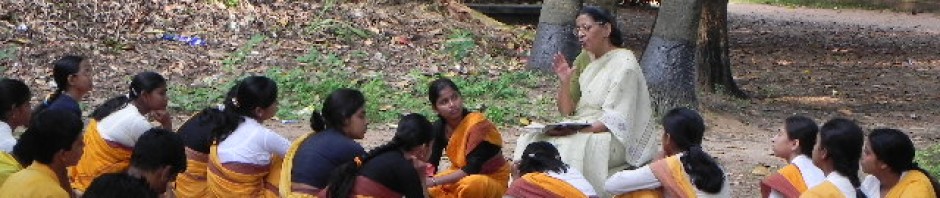
So I separate components—my friendship with Subha & Niladri; the school, including my relationship with the teachers at my table in the staff room at St. John’s & the students & the experience of teaching them and of just being present at the school; my experience of the city itself, it’s culture, history, landmarks, its sheer “overwhelming-ness”; and perhaps most striking, apart from the depth of connection with Subha, are the social service/educational programs, the move toward educating everyone, the exploration of what education is and means in an unfolding democracy.
And I boil the trip down to essential elements—in order that both personally and professionally I might excise and retain the core ideas, ideals and experiences—so they might inspire me now and, I hope, in days to come.
My trip may have started with a stomach-ache (no one escaped the dreaded Delhi-belly), sleeplessness (midnight—really?), homesickness (exacerbated by the long nights), culture shock (heat, crowds, pollution, horns, smells—Kolkata is NOT a Walden experience!) but in the telling and retelling of my story, it glows. Much of what I am distilling, you may have read in its initial form if you followed the blog. This is the story of what is staying with me and why. Here is my distillate:
1. My oxymoronic statements to Mark: I kept telling him he would hate it in Kolkata. After all, he hates the locker room at Lifetime Fitness because it’s crowded. He gets frustrated when there isn’t a bench available for him to sit his gym bag on as he gets ready for spinning class. AND he hates heat. Can you imagine him walking out of the Grand Hotel into the heat and smells and crowds, with beggars tugging on his elbow and vendors imploring him to “just look… my shop is right over here”…and the odors and the constant cacophony of the car horns…?

Yet, I keep telling him that he MUST go back with me. I love the culture and the people, and I need to go back and I want him to experience what I experienced. The kindness, the genuine smiles, the compassion toward the poor. One of the things both Mark and I find most tiresome and disturbing here is the palpable animosity toward the poor*. I never–never once–encountered that in India—and believe me, the poor are there—far more visible than they are here. (And I want him to meet Subha. I want the two of us to hang out with Subha and Dhruba and talk culture and politics and life….)
2. The students: What a pleasure to teach language and literature to kids who are multi-lingual. Most of the girls I taught at St. Johns were at least tri-lingual. The national language is Hindi, their native tongue is Bengali, and the language of the classroom is English. I have always known that multilingualism from an early age enhances brain development, but to see it in action is astonishing. The “prison-house” of language has flexible bars, Niladri, and these kids are facile learners. Here in the USA we tend to be such literalists—we’ve been schooled to be that way. And so we think that a facility with words makes you better only with words, and tend to ignore the greater implication of that—that a facility with words makes you more facile with THOUGHTS. They are better thinkers! Whether I was teaching them vocabulary, grammar, poetry, literature, or just what they call “unseen comprehension”—interpreting an excerpt on the spot—they are much more adept than my American students tend to be. They are more sophisticated thinkers–better at picking up on nuance.

It was delightful to teach in such a classroom, to teach such children, but it saddens me to realize how much we are missing. We still tend to pressure many immigrants to leave their native tongue behind. We fail to support bilingualism in schools, and we reify English as the standard when what we should be reifying is multilingualism, critical perspective and the ability to think and to express what we think clearly and thoughtfully–to use language to discover what we think. We fail to value multi-lingualism and all that it implies. We are missing the boat in a big way. We MUST begin to require a second language—in a deep and significant way—from the earliest grades.

This facility is not limited to the language arts as we like to call them. Our group included two math teachers (one was Ashu, my colleague at St. John’s) and a science teacher and they, too, were impressed by the sophistication of their students. According to Ashu, the 6th graders there were at or ahead of his 10th graders at his private school in North Carolina. Audra, our science teacher, was impressed by the way the different branches of science were threaded throughout the curriculum so that each area (chemistry, physics, biology) was not new when they encountered it in the 9th, or 10th, or 11th grade. It made them more receptive to the material. We were all impressed, regardless of the subject area.
Ashu and I had many long conversations about “rigor,” some between the two of us, some including the teachers at our table in the staff room. He and I intend to pursue the topic and present on it (NAIS, AERA?) and we plan to continue the conversation with Subha, ABan and Sampita from the staff room. (Thank you, digital age).
We also had to call into question some of the broad generalizations leveled at the Indian and American systems of schools. Speaking in the very broadest of terms, the preconception I took with me to India was that in the Indian system teachers teach to high-stakes tests (they do), that learning is largely under pressure (it is) and by rote, and that, such a high-pressure system yields automatons who know the content but don’t really go deep with it (very wrong on that one). Our consolation in the US is our notion that we are educating a large, heterogeneous population (which will limit performance–we are; but so are they) and that we are better at the constructivist approach—that we take the time for a lesson to unfold, that we allow our students a role in that unfolding, and that by definition, means our students are going more deeply into the material. While the early TIMMS studies challenged that notion (here we discovered that we are very worksheet-dependent, and do not go as deep as either Germany or Japan—at least in the classrooms studied), and while there is probably some truth to the notion (we do take more time to allow a lesson to unfold over days and the students are more active participants in that unfolding than in the several classrooms we witnessed—but it is pretty hard to form and follow-up on collaborative groups in a classroom with 60 students in a 40-minute lesson) the Indian students were engaged and engaging, asking and answering provocative questions. They were rigorous in BOTH ways—covering content AND going deep. When they had opportunities to display the application of content material, they rose to the challenge with eagerness and skill.
At any rate, my ultimate point is that while they are preoccupied with coverage, they still ask excellent questions; while they do move at a faster pace than we do, the students, generally speaking, are keeping up with the pace, and they are asking excellent questions. When asked about the material, they are grasping it at a deeper level, and when asked about application, they were capable of applying the knowledge in various contexts.
It’s hardly a scientific study, but it is what we saw in our brief time there. And we reluctantly acknowledged that some of our pacing is not so much because we are allowing the lesson to unfold and the students to drive it, as much as we are giving in to the protests that the material is too challenging and in response we are “dumbing it down,” often for the slower students in the classroom. When we explained this to Mr. Francis, he replied that their students would (“of course”) do the same thing—but they refuse to give into that pressure.
So of course, this goes back to one of our earliest impressions—that of courtesy and a cultural valuing of education. When you walk into a classroom in India, every child stands to greet you, waits to be given permission to sit. Some American teachers were put off by what they perceived as a forced subservience. But it didn’t feel that way to me. (Again—a drive-by observation, but for now it’s all I have.) There is a culture-wide valuing of education that we do not have in the US. It might be a mile wide and an inch deep as we like to say about content coverage, but it is still in place, it is the door through which they enter, and it means they start in different space than we do here. And this leads to one of my other distillates….
[coming next: Systems of culture and education; Flights of compassion and imagination: Half the Sky; compulsory curriculum of compassion; Naba Disha; and Continuing; extending. Connections, collaborations]
*(see today’s New York Times editorial: http://www.nytimes.com/2011/08/31/opinion/the-new-resentment-of-the-poor.html?_r=1)


 There and Back Again: A Teachers Tale