If I needed proof of the truth of Martin Luther King’s statement that “the arc of the moral universe is long but it bends toward justice,” I needed only to come to Kolkata (only!?) where the response to great need, in so many cases, in so many ways, has been great goodness. Mother Teresa was not the first, is not the last, is only the most renowned.

We have been to New Light (http://www.newlightindia.org), Urmi Basu’s shelter (featured in Half the Sky )for trafficked women and their children.
This past week, Subha took us to visit St. John’s Second Schools (small schools set up in slum areas where for part of the day very poor children can attend school in their neighborhood, typically after work); and Mother Teresa’s Motherhouse and Children’s Home. Friday we went to Loreto Sealdah (http://www.loretosealdah.com) to witness Sr. Cyril’s vast conglomerate of social service programs centered around the school. And Saturday we traveled with her students to observe them tutoring children in the villages.
So last Tuesday, Subha took Ashu and me to visit St. John’s Diocesan’s “second schools.” Many area schools have small second schools set up in the slums and poorer areas where children can go to school near their homes. A branch of Diocesan was set up in 2004 in the Bamunbagan slum area, where 26 children are come for two hours in the afternoon. They typically work in the morning—at their family vegetable cart, or at a chai stand or the like. A second school was opened at Bedford Lane, off Ripon Street on Children’s Day in 2005. The school started with 52 children, who are regularly provided with nutritious mid-day meals, uniforms, bags, and books. Here you find the little ones–the school has classes from nursery to standard II. Several of these students go on to Diocesan each year on full scholarship.
The way there:


When we arrived, they had gifts and garlands for us, just as they had at the main school. The children recited poems, sang songs, and three of the older children performed an engagement dance—they were absolutely gorgeous. Beautiful, beautifully dressed in traditional clothing, well-rehearsed in this elaborate dance. It was tremendous. (Ashu was talked into trying the dance. His soccer skills came in handy.) We talked and shared, and promised we’d come back to teach a lesson. I doubt we’ll have time, much to our dismay.


Then we went to the other second school, the one for the little kids:


The kids playing outside:


I had promised my Dad I’d try to get to Mother Teresa’s. I was hoping I could bring him a rosary for his collection. (Can you believe, while in the states, I was imagining a gift shop there? Still think it’s a good idea….) The Motherhouse was, for the most part a shrine—at least the parts we were permitted to see. We could only take photos of the statue/entryway, and the tomb. (Okay—I didn’t know she was literally still there!) Shrines don’t always move me the way programs and people do, but this one was tasteful. Her small, austere room was preserved; there was a mini-museum with a pictorial overview of her life, the tomb…

And the chapel, with the Eucharist displayed on an altar and a small statue of Mother Teresa crouched in the corner in the back of the room in the spot where she would pray.
I wondered if the museum/shrine would mention Sister’s “dark night of the soul,” revealed in letters to a German monk that were made public a year or so ago. They did—it was acknowledged I one of the later panels. She struggled with what she felt was desertion by God, what I would have called depression. It makes me wish so very deeply that we weren’t such literal, fragmented souls (on top of being such fragile souls). If she, or those around her, had the capacity to understand that a spiritual crisis is, if only framed slightly differently, a psychological crisis, perhaps she could have received counseling. Of course, it was an earlier time, and a different era. Psychology was not as developed, nor as accepted as it is now. However, when Time magazine did a feature story on Mother’s spiritual crisis, they too, (even that secular “news” magazine) called it a spiritual crisis, a “desertion” by God, and nothing more. We are so peculiar when it comes to matters of faith. At any rate, it is precisely this untreated or uninterrupted crisis of the soul that makes Mother Teresa so very compelling for me—or rather, makes her sacrifice so great—super-human, in fact. This is how my (small) reasoning goes: Of course she would suffer from depression. How could you live among the poorest of the poor, the sick, the elderly, the dying, in the slums of Calcutta, and not get depressed? For all we know, she may have been suffering from a form of post-traumatic stress disorder. After all, she was working on the front lines of the real “war on poverty.” Now, my reasoning goes, I can see someone choosing to dedicate his or her life to living simply and serving the needy and getting a deep sense of joy and satisfaction from that. As difficult as it may be, if it is your calling, there are benefits to be reaped. I, however, live in fear of depression—I think it can be very difficult to move past, and I find it, even in small doses, debilitating. So here is where –at least for me—Mother Teresa’s sacrifice goes beyond anything I could ever be capable of. This crisis of the soul went on for years. And she stayed. She continued to put the needs of the poor before her own needs. She did not leave for a little r & r. She did not retreat to heal herself in order to return when she was able. She plowed through that darkness—even when she thought God himself had deserted her. Spiderman, Batman, Hercules…something super-human or mythological was at work in her. She had, if not powers, at least capabilities that transcend the mere mortal. She rose above her fragility in ways I cannot fathom.
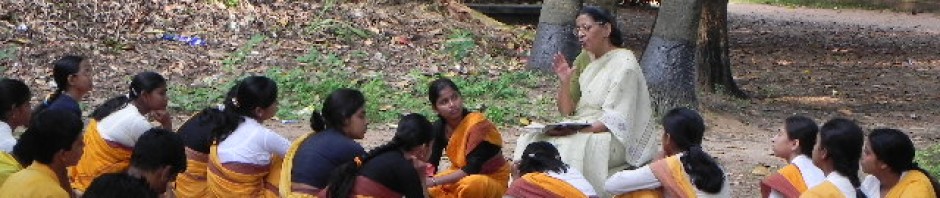
Friday we went to Loreto Sealdah, Sr. Cyril’s school. Another super-human entity, whose down-to-earth demeanor and direct, honest manner belie the steely CEO who obviously directs this social transformation conglomerate. The school is the center–the heart—of her programs. The student body makeup is 50% the poorest of the poor, and which includes programs too numerous for me to remember. They include the 247 street children who live in the school (“We realized the school building stood empty every day from 3 p.m. until 8 a.m. the next morning and there were children living on the street outside,” said Sister), and the Domestic Child Labor Program in which students are to keep their eye out for children kept as domestic labor (i.e., de facto slaves) in their neighborhoods. They knock on the family’s door and do what they can to get the child (typically a girl) out of there (i.e., “we’re starting a neighborhood club for children…”) then ask about their life (are you fed? clothed?, treated well?), then get them out on a regular basis to play, learn, talk…. (Can you even imagine charging an American child with such an important and nuanced task? Not that they wouldn’t be willing or able—it’s just that I cannot imagine such a task presenting itself, nor can I picture us having the imagination to present the task to children.) In the Village Program, Loreto Sealdah students travel an hour by bus to go into the Villages every Saturday (each girl goes once per month) to tutor the children in grades 1-4. They have a “mandatory curriculum of compassion.” Sr. Cyril is one of, if not the most, radical educators—social activist, really–that I have ever met. She says this “is not social work—it’s education for social transformation.”


Sr. Cyril at work:

Saturday, we boarded the bus with her students and headed out into the Village to observe them in their roles as tutors:
Boarding the bus:


Walking to the village:


The local dump?:

At the school:


The 6th graders I observed. They tutored a group of a dozen first graders for 2 hours:

At another Village school:

Village teachers at Loreto Sealdah, engaging in professional development:

“School-in-a-box,” ready to be sent out into the villages & brick factories:


 There and Back Again: A Teachers Tale