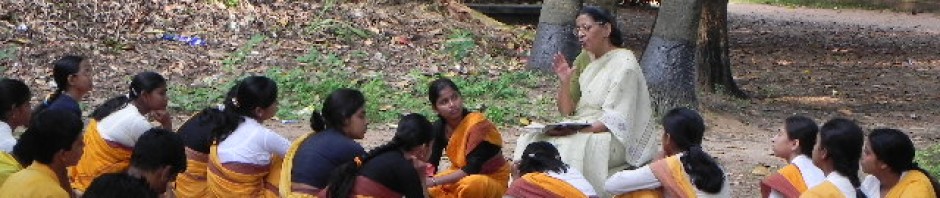
Back to school.
I went to bed early yesterday (10-ish, quite early for me) and so woke up at midnight (!). I stayed in bed until 3, then got up and worked. The morning coffee was greatly appreciated.
It’s Friday, and my second day at the school. Subha is at a Fulbright alum workshop (Really? They couldn’t have scheduled that better?) and so I am in the capable hands of her department. The lovely and now-familiar face of Anuradha Banerjee (who friends call A-Ban) greets me. First I will go to Mrs. Naik’s 8th grade class, then after the late morning tiffin (short snacks) break, Mrs. Banerjee will escort me to her 6th grade class, then to Alka Bhatti’s 8th grade class.
Many things became clearer today. First, the classes do NOT meet only once per week. Many of the main classes meet every day. The one class per week schedule was created to give us a gentle load. The news that the classes meet more frequently is, of course, good news for the kids’ learning, but it is awful news regarding the issue of grading. These teachers give feedback constantly. When the news came down on Wednesday that there was no school on Thursday due to the transportation strike, Mrs. Banerjee’s first thought was that she can get a lot of grading done. The stacks of orange notebooks are ubiquitous. These are the stacks in my immediate periphery today:


(Notice the “tiffin box” next to the stack. That’s for the snack during the 11.10 tiffin break, during which everyone has a small snack. Today one of the teachers shared “laddu”(“something round”) with Ashu and I. It’s a sweet round dessert made from, she told us, dal. Mrs. Chrestien has made arrangements for Ashu and I to get a snack–a sandwich and cup of chai each day during the tiffin break.)

With 60-90 kids per class, and 6-7 classes per day, that’s 360-630 essays to grade—in a single day. And they report that they do read every one. And I watch them do it. These are not short little answers or perfunctory paragraphs. There are pages here that these teachers are carefully editing.
I still have a powerful desire to observe classes. Context is everything and going in to teach them (they want me to teach the way I do at home) without observing how they do it here is a bit discombobulating. I’m very interested in comparative studies, and this fits that model. It is much more meaningful for me to share my methodology in the context of what I see them doing, as in “oh, that’s what you do; here’s how we do that, or here’s how I would handle that.” Without the context in which to compare/share, whatever I choose to do seems rather generic. It may or may not be similar to what they do, it may or may not be familiar, and it may or may not make sense to the teachers or the children.
And the once-per-week schedule is tough. I know they wanted to spread us around in order that more teachers and more children might benefit from what we bring, but so little of what we do at home is a singular, isolated lesson. There is always an introduction, activities, follow-up activities, assessment, and reflection—there is, by necessity, a cycle that must unfold over time. Isolated little teaching demonstrations are not really congruent with the way we typically plan and teach in the U.S. , unless they can be placed into a context.
But the children are delightful—so very polite and curious. I wish I were a more fun interviewee—I have the curse of the English teacher, seeing multiple layers and points of view in everything. I struggle with their simple questions. My favorite writer? Certainly not anyone they’ve ever heard of, especially not the younger children. Favorite movie? I have a million—which might be recognizable to them? Favorite cartoon character? Rocko’s Modern Life is old in the U.S. and there were many people who did not recognize it when it WAS on! I try to think of a more contemporary and popular cartoon character, but on the spot, I fail. My favorite food? I have so many favorites; do they mean dish or type; what response might have significance to them? So I tell them that in America we like ethnic foods—Thai, Indian, Mexican, and that sometimes we question what constitutes American food—macaroni & cheese and hamburgers? (Pizza is Italian, isn’t it? Wikipedia says Italy got it from the Middle East…. gosh, even that isn’t ours?) The kids are gracious—asking simple, generic questions that any fool could answer in a lovely attempt to get to know me, and I make it difficult. Sigh.
They want to know about our school, our food, our lifestyle. They want to know what I think of Kolkata; they tell me that it is the City of Joy (because of the joyful people, and because their specialty is sweets) and the City of never-say-die. They are clearly proud of their city and country. They want to know what my favorite Indian state is. I have to ask them if West Bengal is a state, then I tell them that it is my favorite. Some want to know if I have chosen their school in particular, others want to know what I think of their school. I think it’s lovely, warm and welcoming.
It is hot and humid in the classroom—even with the shutters open (no windows or screens). We close the shutters and doors to staunch noise. (The kids offered.) On my way back to the faculty lounge, I realize that every inch of me is sweating and my shirt has damp marks. The fan in the teachers’ lounge (Lounge does not see like the right term—I think I’ll go with ‘workroom’ for now. I’ll pay closer attention to what the staff calls it.) is so very welcome. But it makes it hard for teachers to keep paper in place during their constant grading.
Ashu is amazed at the abilities of the 8th graders in math. He says that our 10th graders could not compete, that they would never take on the challenging tasks offered, that the teachers would never ask it—we would consider it too hard, and would anticipate a great deal of resistance.
As I peruse the English books, there are lots of places for critical thinking and discussion. I ask the 8th graders today if they discuss literature in their classes. Oh yes, Mum, they respond. And they demonstrate how one at a time they stand at their seat and contribute to the conversation. My desire for just a modicum of observation raises its head again. I’ll discuss it with Subha tomorrow. Mrs. Bhatti says that I could observe her class—she will check with the Vice Principal to see if it is okay.
Today was Friday, so they collected an onion and a potato from each of the four thousand students to take to St. Joseph’s old age home run by the Little Sisters of the Poor. They have been doing this since 1990. Do the math. That’s a lot of onions and potatoes.


Some of the younger teachers discuss the saris that all of the teachers wear. I ask if it is in order to establish a more formal atmosphere at the school. (Mrs. Chrestien asked Ashu to wear a tie every day; he was dismayed that he only brought four.) They tell me that only old women wear saris and that this is the first time they’ve had to wear them, that it takes a long time to put them on in the morning. One teacher says she has it down to about a 10-minute procedure now, and an older teacher says she can do it in about 5 minutes now. I ask them if they wear salwar kameez at home, they say yes—or jeans.

Bree wore shorts to the monument yesterday and started to feel a few stares—I thought they were subtle at best, at times wondering if perhaps it was mostly in her head until two small boys dissolved into fits of laughter at the sight of us. Their mother hushed them. Then we hit the streets on our way back to the hotel. Most definitely NOT in her head. The proportion of men to women on the streets of Kolkata seems to be somewhere around several hundred to one, and the men’s heads were swiveling on their necks to check out Bree’s legs. Okay she says—shorts are for inside the hotel only.

Tomorrow St. John’s has a staff development program that runs from 9 a.m. until 4p.m. Ashu and I plan to attend the morning. None of the teachers know what is to be presented, and in fact they say they typically have one day like this per year and they’ve already had it, so this is a mystery. What better way to get a sense of the teacher culture than to attend a Saturday professional development session with them?
Along with the wake-up coffee and newspaper (We could get used to this part. Keturah says they will have to drag her out of here screaming in August.) the two daily mangoes, complete with a finger bowl with a floating flower, always makes my day.

I didn’t eat them every day at first, and so started a bit of a stockpile of mangoes in my refrigerator. Ashu suggested I sell them on the street. Today I had an old one on my nightstand, planning to eat it before it got any older. The thoughtful and polite Gourav, the son of two teachers who decided to go into hotel management instead, and who often cleans my room, came in for evening preparations, saw the old mango and offered to get me a fresh one. I said no need, asked if perhaps I should just discard this one, but he insisted on getting me a fresh one. He’d already replaced the two I’d eaten, so today I had five fresh mangoes! They are becoming as intrinsic a part of my afternoon as the 3 a.m. wake up is a part of my morning.
Most of the rest of the group goes out to see a Bollywood movie tonight, but after my late-afternoon mango snack, my body recognizes what it classifies as night, and goes right into coma mode, and I miss the time to congregate. I sleep like I’m dead, ensuring that I will be up again at three. I’m sad I missed it. Apparently several of our group now have a crush on a hunky Bollywood star. Darn it.


 There and Back Again: A Teachers Tale