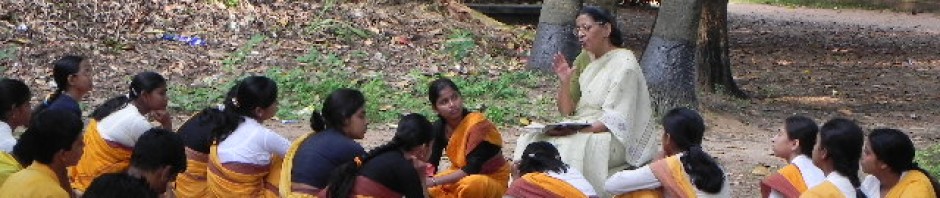
वापस स्कूल करने के लिए स्वागत करते हैं
That is “welcome back to school” in Hindi. (I hope—my source was the Internet!)
My first day of school! Here at last.
Lateness should not be an issue. My 3:20 rising time seems to be the standard. I’m embracing it—blogging and organizing pictures in the morning. The truth is I’m too tired to do it in the evening, so maybe this will work. I’ll just have to go to bed earlier. The coffee that arrives with the morning wake-up call helps too, although it too highlights the discrepancy between our digs here at the luxury hotel and spa and everything that surrounds us here in the heart of Kolkata. It is a refuge that several teachers have commented on—to the effect that teachers don’t travel like this—businessmen and the wealthy travel like this. We are grateful for the pampering.
So by the time Ashu and I convened in the lobby to wait for our driver, I’d been up for 5 hours.

I was worried about making it through the day. There was no need. There was enough action and excitement to carry me through several days. (Staying awake through dinner was another story. I looked around the table at a lot of flagging eyelids. It was a demanding day for everyone.)
So 8 a.m.: Subha had told us that we were to be picked up between 8 & 8:15. I’ve been getting used to Kolkata time—remember the photo shop that was supposed to open at 10:30? But, I reasoned that school is one place where timeliness will be paramount. After all, we are talking about a school of 4,000 girls, 60-90 in a classroom, 40 minute periods (at most—some are 35). Back at home we are always talking about “effective use of instructional time.” (Time is money!!! Remember? And we have a habit of referring to “wasted” time. Do we use metaphors in all the wrong places?)
At 8:20 I called her, and her relaxed and cheerful response was—yes, yes, the driver left 5-10 minutes ago, and there is traffic (there’s always traffic—with one exception that I will get to at the end of this post). My first impression is that the school is absolutely beautiful. Aqua-washed stucco buildings surround an open courtyard.

The greenery is lush. One of the first charming sights is the primary school lining up in the courtyard:


When we arrived, we walked past a beautiful, detailed mosaic maid from flower petals in honor of the occasion of our coming.

The class office bearers greeted us with garlands of flowers (heavy garlands of fresh flowers) and presented them in a brief ceremony that included candles and an anointing of our foreheads. Anisha, the school captain (who reminded me so much of any of our most poised and talented girls) ran the show along with the Vice Captain Toshita, the games captain Madhurima, and the social secretaries Smita, Soulina and Mohona.


On our way to the office of the rector we passed through the primary building where we met Mrs. Sen, the head of the primary division.

As we walked by the classrooms, every head was craning for a look at us—the visitors. If I waved, sixty little hands and sixty smiles were the result. As we walked through the halls, all but the most shy would greet us—“good morning, mum,” over and over. If I could take the time to return the greeting and ask “how are you?” the response was a delighted smile, and a “fine, how are you?” Even the shy girl would get brave and offer her greeting, hoping for a personal response. Maybe the burden of stardom isn’t so bad!
Then it was time to meet Mrs. Rosita Chrestien, the rector (she’s much more than a principal—a lifelong educator who worked with Mother Teresa, and is responsible for the warm, inclusive philosophy and atmosphere of the school) where we had tea and met the vice principal (akin to our role of Curriculum Director or Dean of Studies) Mrs. Carolyn Lionel.

We learned a bit about the long and colorful history of the school (the Archbishop of Canterbury visited last year!) and shared descriptions of our schools. I shared some of my own photos and a magazine and a bit of literature from Gilmour Academy (www.gilmour.org) but they had already thoroughly checked it out on the web. I gave Mrs. Chrestien a copy of Dave Lucas’ new book of poetry (http://www.ugapress.org/index.php/books/weather/) and Ashu presented her with a beautiful photography book featuring North Carolina.
Subha has been telling me bits about Mrs. Chrestien and how much she respects her. I hope that I have the opportunity to spend a bit more time with her, perhaps get her perspective on education. I’d love to learn the story of her career. (http://stjohnsdiocesanschool.org/page_2_principals_desk.html)
According to Subha, she took more time with us than is typical.
The school mission and commitment to service reminds me very much of Gilmour’s mission. One of their most arresting programs, initiated in 1990, has become a tradition. Each Friday, each child brings in one onion and one potato. The girls collect these in large sacks and each week they deliver 4000 onions and 4000 potatoes to St. Joseph’s old age home run by the Little Sisters of the Poor which is just down the street from the school. http://stjohnsdiocesanschool.org/page_21_social_services.html
Next we went to the third (fourth?) floor to the AV room where half the faculty had convened to meet us. They had me lead (I didn’t know where I was going!) and I walked in, only to notice a few minutes later that I was the only one in the room with my shoes on. Somehow I managed to walk past the 60 pairs of shoes on the floor and not even notice—much less think of taking off my own. They assured me that it was fine.
In a wonderfully thoughtful ceremony, we were introduced by Mrs. Lionel who embarrassed us by reading selections from our bios, and we were given an overview of the school from the office bearers who had obviously painstakingly memorized their parts. Several girls sang for us—beautiful voices and beautifully rendered songs in Hindi, Bengali and English.


A bit later the art teacher also sang for us. Each teacher stood and introduced him or herself (two men, approximately 60 women—but that was only half the faculty. I assume the other half was tending the flock.) Their subjects included physics, English, Bengali, Hindi, psychology, geography and more. Many teachers announced that they taught several sections of 11th and 12 levels (their 12-grade system is akin to ours)—and 5th! We had tea, and it was time to move on to the faculty room and wait for my first class.
Right now, I’m scheduled for 2, 3 or 4 classes (out of eight 40 minute periods) on any given day—but I’m learning that all of that is very fluid. For the first day, I would go into three classes (if it’s too much, let me know, Subha says—are you kidding? I’m used to three 90-minute classes in a row. This is a piece of cake—even in the oppressive heat.) The faculty is very friendly, and they promise to keep me company, but they clearly use any time they have to grade. They have stacks of kids’ composition books in front of them, and they waste no time. They are warm and friendly to me, but I’m pretty sure that I am taking their precious work time.

The first class I’m scheduled to attend is VI-D—a group of 6th graders. It begins at 11.30—immediately following the 11.10-11.30 break (there is no passing time here). Ashu and I are presented with a sandwich and tea at 11.20—and I’m wondering how on earth this is going to work. They are all sharing the snacks they brought from home—with us and with each other. Here, too, they are relaxed about the time. At the appropriate time, they move in that direction. It seems that the kids are good—it’s not a big deal if you aren’t there right at the exact moment.
So—the 6th graders. I was most anxious to see what 60 kids in a room looked like. It looks like this:


They are in a room that we would consider small for a class of 25. I go through the door and they all rise and greet me. I don’t see anywhere for a teacher to stand or sit. Subha points me to a desk in the right front corner of the room—literally squeezed in against students’ desks. There is a narrow passage along the front of the room, against the chalkboard, leading to the desk and a small space in which to stand.
Sixty expectant faces look at me—Subha is about to leave me with them until their teacher returns (momentarily). I say hello, and ask them what they’ve been working on in this class. They look bewildered. What have you been reading and writing? They still look bewildered. One obvious smart, energetic class leader takes it on and tries to respond—but we are on a different wave length. I’m getting nervous, thinking that this is about to become a very long 40 minutes. Well 35. Their regular teacher Mrs. Biswas, a very young and beautiful woman (if there were boys here, every one of them would have a crush on her), comes soon and encourages me to just tell them about myself and to ask and answer questions. What do they want to know? The real question quickly becomes what don’t they want to know. We talked school (what are students like in the US?), geography (there ARE five Great Lakes right? And Lake Erie is the shallowest but not the smallest, right? Dang, I should have boned up on geography for this…), Where is Ohio? (About a third of the way into the map from the right? How do you answer that without a map in front of you?) I promised to come back with a list of my favorite writers. One shy girl pulled out her copy of C.S. Lewis and asked me if that was a good author. (Oh, yes, I assured her. I asked if she and her classmates are reading the Twilight series—Subha had mentioned that it is very popular at the school, but I don’t know if 6th graders read that. My young friend said no. I’m not exactly sure what the no was in reference to. Her own reading? 6th graders in general? The quality of the book?)
Then I made a gaff. Subha had told me that the teachers move from class to class—the kids stay put. I knew that, but my subconscious triggers were waiting for the kids to leave. Funny how deeply embedded practices become. So the kids rose to their feet, class was over, and the questions kept coming (there are more than 60 of them after all). I kept answering questions—doing what I do back at home, stealing those between-class moments for some individual attention. Well, Mrs. Biswas was waiting—as was her next class, my next class, and the teacher who would be coming in here next. They are so wonderfully relaxed though—she didn’t seem to mind at all. She gave me the ambiguous side-to-side head-nod. Is it yes? Is it no? You’ll never know.
Next is Subha’s 12th grade class—a rare treat as it is, I believe, a self-selected group of senior girls who wanted to take on an extra challenging language class. It was a small group, akin to a seminar class at home—perhaps twenty in the room. (More accurate details will come in subsequent posts.)

We’re going to do some poetry (Maya Angelou’s “Still I Rise”) and personal essays—much like what I do with American seniors and the college essay. Subha is trying to arrange for us to have an 80-minute period in which to do writing workshop (we’ll have to schedule the AV room).
I think it will be AWESOME. These girls are so bright and so articulate. They want to know about American colleges, and the American system, and American recipes (salads!)—and they have big plans for our time together. They too were full of questions.
My last class is Mrs. Dasgupta’s 12th graders:

This is a large class, too, and they will be studying “Unseen Comprehension.” That means just what it sounds like—I am to choose a paragraph from a text book that I have and they do not. And I ask them questions. There are questions in the book designed to measure comprehension—fill in the blanks, short response (30 words or less) and arranging 5 sentences in chronological order according to the logic of the passage. It’s very literal. But Subha has told me that I can go beyond what the textbook requires, developing questions that go deeper. Most of the passages are factual or informative. Issues are only implicit here—so they are not passages chosen to facilitate discussion—that’s not the goal of the text. But as I listen to Subha and the other teachers, it is their goal. So the passage I choose has to do with drug abuse—something that we can discuss a bit and at least render an opinion on. The passage will have to be copied. I forgot to mention Rosemary, the school secretary, introduced to us by Subha first thing. As in many schools, she is a very important person to know. I’ll be visiting her tomorrow.
At the end of the day, Ashu and I wait for our driver (From now on we will take a taxi. The driver’s wife took ill or something and we won’t have that luxury for the month. That’s okay—I think we have enough luxury and the taxi rides are certainly a big part of the culture.) We are handed a plate with a banana and an apple. We compare notes. He says the the 8th graders, even in these large classes, with only a chalkboard at the front of the room, are doing work that our 10th graders would struggle with back home.
I had been telling him about Stigler & Hiebert’s The Teaching Gap—a processing of the TIMSS study (http://www.iea.nl/timss2007.html), a comparative study of 8th grade math classrooms in Germany , Japan and the US in which the US is shown to be the weakest in terms of application and critical thinking. It seems that we are very directive and work-sheety. We tend to judge other cultures for what we see as a reliance on rote learning and memorization, and like to think that we do a better job of “going deep.” I often wonder how much brain development is lost with our aversion to memorization. We do have a habit of “throwing the baby out with the bathwater,” (see the whole language movement. Never once did it forbid grammar instruction—just asked that it be done in a meaningful context) and I for one wish that I was a bit more disciplined in that way. At any rate—here we were again, looking at evidence (albeit a tiny piece) that maybe we in the US are too lax. Ashu and I found ourselves wondering if the “resources” (“gadgets?”) aren’t a distraction. (See Jane Healy’s book Failure to Connect—it’s dated, but makes a very interesting point still relevant to his conversations.)
So we returned to our hotel/spa, to our refuge, to reflect. There is much to reflect on after only one day. We are excited to get into a routine—but I think I forgot to mention that each class meets only once per week—that’s right—60-90 kids, 40 minutes, once per week, and the math kids are ahead of ours. Okay—that’s crazy. Maybe we’ll that picture will develop differently as our time goes on, but I do have to wonder who is going to learn more here.
Ashu and I are wondering where we might get an onion and a potato for Friday, and we are very disappointed to learn that we won’t have school tomorrow. There is a transportation strike—only for one day, but apparently many of the 4000 students use public transportation to get to school, so we will meet on Saturday, August 6th to make up for tomorrow. Shoot. This is making it very hard to sink into a routine…but it I am also eager to see Kolkata streets without taxis or buses. We might practice our 2.4 kilometer walk to the school; we might take in some of the sights. As cars do not stop for pedestrians here (I’m telling you–the streets are a veritable miracle here. I watch the car heading toward the pedestrian and cannot tell you why they don’t collide. I’m a little worried about my safety (not to worry—I’ll be careful) but I tend to panic when a moving car is coming at me at a good clip and I stop. I think that messes with the elaborate and intricate choreography that is required for this miracle to continually occur. At any rate—so much more to tell; all in good time.

our mentors:


 There and Back Again: A Teachers Tale