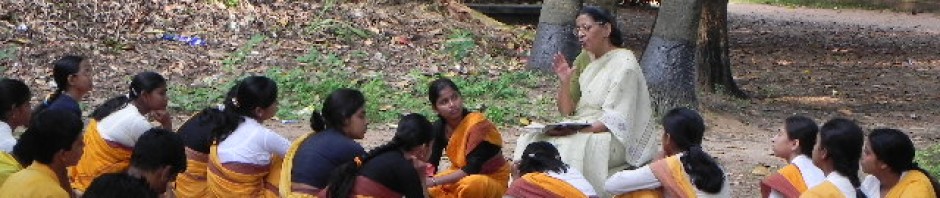
As I prepared to travel to Kolkata for a month in an English classroom here, teaching with Subhalakshmi (Subha), already a warm and welcoming friend by virtue of our e-mail exchanges, I developed a handful of questions, the first of which is ‘how many of these will remain relevant once I get there?’ The most compelling questions (I’m tempted to write ‘of course’ here), are those that arise in context. So I’m laying out my questions and reflections, knowing that they may immediately become irrelevant.
My questions include global, local, and personal elements. On a global level, I wonder about India’s emerging democracy. They are climbing out of a caste system, while we seem, in so many ways, to be heading into, if not class warfare, at least a class struggle that we are, for better or for worse, finally acknowledging enough to begin developing the ability to articulate. We have been reluctant to acknowledge the increasingly sharply drawn class divides in American culture given our tightly held notions of democracy. But as capitalism continues to trump democracy in so many ways, not the least of which is the current wave of union-busting (my home state of Ohio, along with Wisconsin, is leading the way) targeting teachers and, in some states police and other service providers, tax breaks for those earning over $250,000 per annum continue “because those people have mortgages to pay and children to put through college.” (http://www.thedailyshow.com/watch/thu-march-3-2011/crisis-in-the-dairyland—for-richer-and-poorer—teachers-and-wall-street)
India and the U.S. have much in common—but wonder if perhaps India is on an uphill trajectory, trying to work their way out of (albeit deeply held) social and class distinctions, while we are being forced to acknowledge that in spite of our best intentions, our class distinctions are not only present, but deepening. According to Culture Grams'(www.culturegrams.com)description of India, “High-technology industries lead the way for industrial growth…. Serious gaps exist between the urban wealthy and the poor. … Obstacles to economic growth include outdated or nonexistent infrastructure, lack of educational opportunities, and insufficient economic opportunities for the population. Approximately 25 percent of the population lives in poverty.” (According to the New York Times, citing statistics from the U.S. Census Bureau, the U.S. poverty rate, as of Sept. 2010 is 14.3%.) India is, it seems, one of the few growing economies in the industrial world. Ideologically and economically, they are in growth stages; we seem to be on the downhill side of our euphoric growth. Are we, the youngsters in the world, an aging democracy? If so, it was certainly a short life cycle. Are there lessons to be learned there for emerging democracies?
On a different note, I have many questions about the educational system. My work is centered around the messy project of developing authentically student-centered classrooms. My project, “What Does it Mean to Think Like a Teacher,” builds on Howard Gardner’s notion that children enter their years of schooling with powerful, deeply embedded theories about how the world works. He argues that the only time these intuitive theories are interrupted or changed–the only time we fundamentally alter the way we think–is when we think “disciplinarily.” We change, for example, not when we study grammar but when we think like a writer; not when we read a textbook, but when we think like a historian; not when we memorize the periodic table, or learn a theory or a formula, but when we “think like a scientist.” In this project, I ask teachers to reflect on what it means to think like a writer, mathmetician, historian, etc. More importantly I ask them what it means to ask students of any age what it means to do the same. My goal is to try to equate that with thinking “like a teacher.” I am hoping that this project will resonate with teachers in India; that I can gather some responses from them. We’ll see.
Subha is trying to be gentle with me, and so far has mentioned only teaching creative writing and working with students who might benefit from working with a native English speaker. That is fantastic, and I have the material I use to set up writing workshop in the classroom, but I am also taking along the material we use in our unit on analyzing advertising (focusing on representations of women in ads–Subha’s si an all-girls school), material introducing Socratic seminar to the students, and our school-wide re-reading project in which students read and reflect on a beloved piece of literature from their childhood or adolescence. I’m also bring two copies of Nicholas Kristof and Sheryl WuDunn’s book, Half the Sky: Turing Oppression in to Opportunity for Women Worldwide, hoping that Subha and I might read it together during the month I am here, and perhaps turn it into a unit of study for students at our respective schools in which we might continue our collaboration.
I am also looking forward to experiencing the culture. Last March I had the good fortune to travel to Ireland on a family trip. There, the consistently warm reception we experienced everywhere we went stood in sharp contrast to the often chilly, sometimes even rude reception one might get in the U.S. Not that there are not many warm and wonderful people in the U.S., but too often they are much like the two young women waiting on several of us at a sandwich shop in Dulles airport on Friday evening. They made no pleasantries, did not meet our eyes, and seemed unhappy with their jobs—particularly when we asked for a cup of water to go with our sandwich. The warm, ice-less water did seem a reflection of their attitude. From all I have heard, I expect India to be much like Ireland where folks are generally warm and glad to see you.
In Ireland, I was reminded of the culture-jolt (not big enough to be a culture shock! Sorry Alvin Toffler.) I experienced when I went to college. I was sitting expectantly in my first class, on the first day, when the professor walked in. My immediate impression was that he was physically one of the funniest-looking men I’d ever seen. He had a beaked nose and uncommon words like stout and portly come to mind. He reminded me of a turtle walking on its back legs. We might think things like that (right?) but in civilized society, we keep our mouths shut (right?). My reaction—one which I’d never taken note of before—was a stiffened spine in anticipation of the whispering and murmuring, the disrespect that I instinctively anticipated coming from the rest of the class. (I’d not previously noted how uncivilized my high school experience was–the fish unaware of the water….) There was no whispering, no giggling, and I relaxed my spine and breathed a sigh of relief. I remember thinking—“That’s right. These people want to be here. The culture will be different.” And it was. I felt the same sort of relaxation in Ireland where I knew that every shopkeeper would greet me warmly and engage in conversation. From all I hear, I expect a similar culture in Kolkata. We’ll see.


 There and Back Again: A Teachers Tale
awesome pictures Cindy! I am so enjoying this.
Cindy, so glad to be on this journey “with you.” Amazing…